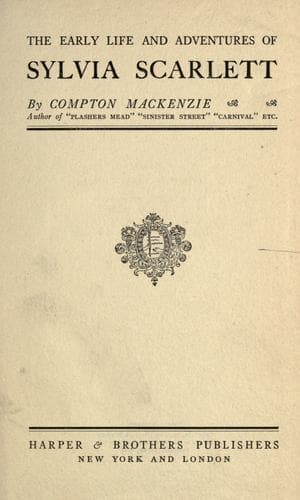
The Early Life and Adventures of Sylvia ScarlettMacKenzie, Compton
General
The Early Life and Adventures of Sylvia Scarlett
MacKenzie, Compton
Fiction
Sylvia bade him come in the morning; with a deep bow to her and to the
stranger he departed, twanging his guitar. Mrs. Gainsborough, who by
this time had reached the point of thinking that her American widower
existed only to be oracular, wished to ask his advice about the
stranger, and was quite offended with Sylvia for telling her rather
sharply that she did not want all the inmates of the pension buzzing
round the frightened child.
"Chocolate would be more useful than advice," Sylvia said.
"I know you're very down on poor Mr. Linthicum, but he's a mass of
information. Only this morning he was explaining how you can keep eggs
fresh for a year by putting them in a glass of water. Now I like a bit
of advice. I'm not like you, you great harum-scarum thing."
Mrs. Gainsborough was unable to remain very long in a state of injured
dignity; she soon came up to Sylvia's bedroom with cups of chocolate.
"And though you laugh at poor Mr. Linthicum," she said, "it's thanks to
him you've got this chocolate so quick, for he talked to the servant
himself."
With this Mrs. Gainsborough left the room in high good humor at the
successful rehabilitation of the informative widower.
The girl, whose name was Concetta, had long ceased to lament, but she
was still very shy, and Sylvia found it extremely difficult at first to
reach any clear comprehension of her present trouble. Gradually,
however, by letting her talk in her own breathless way, and in an odd
mixture of English, French, German, and Italian, she was able to put
together the facts into a kind of consecutiveness.
Her father had been an Italian, who for some reason that was not at all
clear had lived at Aix-la-Chapelle. Her mother, to whom he had
apparently never been married, had been a Fleming. This mother had died
when Concetta was about four, and her father had married a German woman
who had beaten her, particularly after her father had either died or
abandoned his child to the stepmother--it was not clear which. At this
point an elder brother appeared in the tale, who at the age of eleven
had managed to steal some money and run away. Of this brother Concetta
had made an ideal hero. She dreamed of him even now and never came to
any town but that she expected to meet him there. Sylvia had asked her
how she expected to recognize somebody who had disappeared from her life
when she was only six years old, but Concetta insisted that she should
know him again. When she said this, she looked round her with an
expression of fear and asked if anybody could overhear them. Sylvia
assured her that they were quite alone, and Concetta said in a whisper:
"Once in Milano I saw Francesco. Hush! he passed in the street, and I
said, 'Francesco,' and he said, 'Concettina,' but we could not speak
together more longer."
Sylvia would not contest this assertion, though she made up her mind
that it must have been a dream.
"It was a pity you could not speak," she said.
Public-domain text, read in full here on John Shaqi.
Reviews
Reviews
No reviews yet
Be the first to share your thoughts on this work.
Elsewhere in the archive
Join the Discussion
Join the discussion
Sign in to leave a comment or review.
Sign InorCreate an account