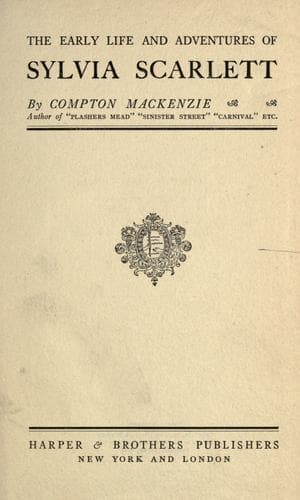
The Early Life and Adventures of Sylvia ScarlettMacKenzie, Compton
General
The Early Life and Adventures of Sylvia Scarlett
MacKenzie, Compton
Fiction
Early summer passed away quickly enough in constant rehearsals. Sylvia
was pleased to find that she had been right in supposing that the state
of domestic affairs would be improved by Jimmy's plan. Mabel turned out
to be a good singer for the kind of performance they were going to give,
and the amount of emotion she put into her songs left her with less to
work off on Henry, who recovered some of his old self and was often
really funny, especially in his duologues with Monkley. Sylvia picked
out for herself and learned a few songs, most of which were condemned as
unsuitable by Jimmy. The one that she liked best and in her own opinion
sang best was the "Raggle Taggle Gipsies," though the others all
prophesied for it certain failure. Monkley himself played all the
accompaniments and by his personality kept the whole show together; he
also sang a few songs, which, although he had practically no voice,
were given with such point that Sylvia felt convinced that his share in
the performance would be the most popular of the lot. Shortly before
they were to start on tour, which was fixed for the beginning of July,
Monkley decided that they wanted another man who could really sing, and
a young tenor known as Claude Raglan was invited to join the party. He
was a good-looking youth, much in earnest, and with a tendency toward
consumption, of which he was very proud.
"Though what there is to be proud of in losing one of your lungs I don't
know. I might as well be proud because I lost a glove the other day."
Henry was severe upon Claude Raglan from the beginning. Perhaps he
suspected him of admiring Mabel. There was often much tension at
rehearsals on account of Henry's attitude; once, for instance, when
Claude Raglan had sung "Little Dolly Daydreams" with his usual romantic
fervor, Henry took a new song from his pocket and, having planted it
down with a defiant snap on the music-stand, proceeded to sing:
"I'll give him Dolly Daydreams
Down where the poppies grow;
I'll give him Dolly Daydreams,
The pride of Idaho.
And if I catch him kissing her
There's sure to be some strife,
Because if he's got anything he wants to give away,
Let him come and give it to his wife."
The tenor declared that Henry's song, which was in the nature of a
derogatory comment upon his own, could only have the effect of spoiling
the more serious contribution.
"What of it?" Henry asked, truculently.
"It seems to me perfectly obvious," Claude said, with an effort to
restrain his annoyance.
Public-domain text, read in full here on John Shaqi.
Reviews
Reviews
No reviews yet
Be the first to share your thoughts on this work.
Elsewhere in the archive
Join the Discussion
Join the discussion
Sign in to leave a comment or review.
Sign InorCreate an account