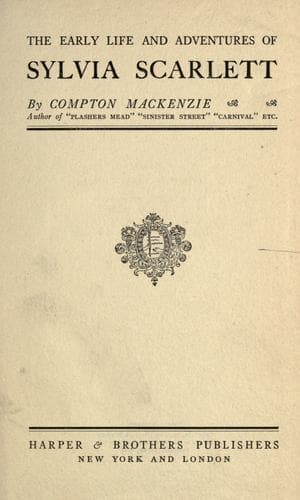
The Early Life and Adventures of Sylvia ScarlettMacKenzie, Compton
General
The Early Life and Adventures of Sylvia Scarlett
MacKenzie, Compton
Fiction
"You don't think he took the knife to kill himself?" she asked.
"More likely he took it with some idea of killing them, and, being
drunk, fell over the cliff. Poor old Harry! I shall miss him, and now
you're all alone in the world."
That was true, and the sudden realization of this fact drove out of
Sylvia's mind the remorse for her father's death by confronting her with
the instancy of the great problem that had for so long haunted her mind.
She turned to Jimmy almost fearfully.
"I shall have you to look after me?"
Jimmy took her hand and gazed into her eyes.
"You want to stay with me, then?" he asked, earnestly.
"Of course I do. Who else could I stay with?"
"You wouldn't prefer to be with Claude, for example?" he went on.
"Claude?" she repeated, in a puzzled voice. And then she grasped in all
its force the great new truth that for the rest of her life the choice
of her companions lay with herself alone. She had become at this moment
grown up and was free, like Mabel, to choose even a man with a yellow
cummerbund.
CHAPTER IV
Sylvia begged Monkley not to go back and live in Fitzroy Street. She
felt the flat would be haunted by memories of her father and Mabel. It
was as well that she did not want to return there, for Jimmy assured her
that nothing would induce him to go near Fitzroy Street. A great deal of
money was owing, and he wished the landlord luck in his dispute with the
furnishing people when he tried to seize the furniture for arrears of
rent. It would be necessary to choose for their next abode a quarter of
London to which he was a stranger, because he disliked having to make
détours to avoid streets where he owed money. Finsbury Park was
melancholy; Highgate was inaccessible; Hampstead was expensive and
almost equally inaccessible; but they must go somewhere in the North of
London, for there did not remain a suburb in the West or South the
tradesmen and house-owners of which he had not swindled at one time or
another. On second thoughts, there was a part of Hampstead that was
neither so expensive nor so inaccessible, which was reached from
Haverstock Hill; they would look for rooms there. They settled down
finally in one of a row of old houses facing the southerly extremity of
the Heath, the rural aspect of which was heightened by long gardens in
front that now in late summer were filled with sunflowers and
hollyhocks. The old-fashioned house, which resembled a large cottage
both without and within, belonged to a decayed florist and nursery
gardener called Samuel Gustard, whose trade was now confined to the sale
of penny packets of seeds, though a weather-beaten sign-board facing the
road maintained a legend of greater glories. Mr. Gustard himself made no
effort to live up to his sign-board; indeed, he would not even stir
himself to produce a packet of seeds, for if his wife were about he
would indicate to her with the stem of his pipe which packet was
Public-domain text, read in full here on John Shaqi.
Reviews
Reviews
No reviews yet
Be the first to share your thoughts on this work.
Elsewhere in the archive
Join the Discussion
Join the discussion
Sign in to leave a comment or review.
Sign InorCreate an account