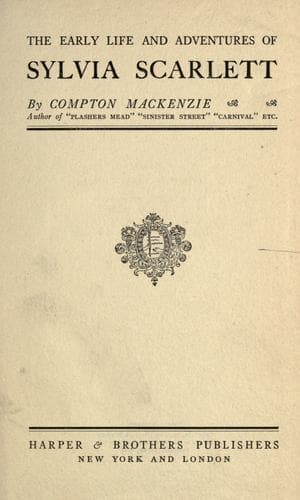
The Early Life and Adventures of Sylvia ScarlettMacKenzie, Compton
General
The Early Life and Adventures of Sylvia Scarlett
MacKenzie, Compton
Fiction
Monkley so much disliked Sylvia's intimacy with Arthur that he began to
talk of moving from Hampstead, whereupon she warned him that if he tried
to go away without paying the rent she would make a point of letting Mr.
Gustard know where they had gone.
"It strikes me," Monkley said, and when he spoke, Sylvia was reminded of
the tone he used when she had protested against his treatment of Maudie
Tilt--"it strikes me that since I've been away you've taken things a bit
too much into your own hands. That's a trick you'd better drop with me,
or we shall quarrel."
Sylvia braced herself to withstand him as she had withstood him before;
but she could not help feeling a little apprehensive, so cold were his
green eyes, so thin his mouth.
"I don't care if we quarrel or not," she declared. "Because if we
quarreled it would mean that I couldn't bear you near me any longer and
that I was glad to quarrel. If you make me hate you, Jimmy, you may be
sorry, but I shall never be sorry. If you make me hate you, Jimmy, you
can't think how dreadfully much I shall hate you."
"Don't try to come the little actress over me," Monkley said. "I've
known too many women in my life to be bounced by a kid like you. But
that's enough. I can't think why I pay so much attention to you."
"No," Sylvia said. "All the women you've known don't seem to have been
able to teach you how to manage a little girl like me. What a pity!"
She laughed and left him alone.
There was a halcyon week that February, and Sylvia spent every day and
all day on the Heath with Arthur. People used to turn and stare after
them as they walked arm-in-arm over the vivid green grass.
"I think it's you they stare at," Sylvia said. "You look interesting
with your high color and dark curly hair. You look rather foreign.
Perhaps people think you're a poet. I read the other day about a poet
called Keats who lived in Hampstead and loved a girl called Fanny
Brawne. I wish I knew what she looked like. It's not a very pretty name.
Now I've got rather a pretty name, I think; though I'm not pretty
myself."
"You're not exactly pretty," Arthur agreed. "But I think if I saw you I
should turn round to look at you. You're like a person in a picture. You
seem to stand out and to be the most important figure. In paintings
that's because the chief figure is usually so much larger than the
others. Well, that's the impression you give me."
Speculation upon Sylvia's personality ceased when they got home; Monkley
threatened Arthur in a very abusive way, even going as far as to pick up
a stone and fling it through one of the few panes of glass left in the
tumble-down greenhouse in order to illustrate the violent methods he
proposed to adopt.
The next day, when Sylvia went to fetch Arthur for their usual walk, he
made some excuse and was obviously frightened to accompany her.
Public-domain text, read in full here on John Shaqi.
Reviews
Reviews
No reviews yet
Be the first to share your thoughts on this work.
Elsewhere in the archive
Join the Discussion
Join the discussion
Sign in to leave a comment or review.
Sign InorCreate an account