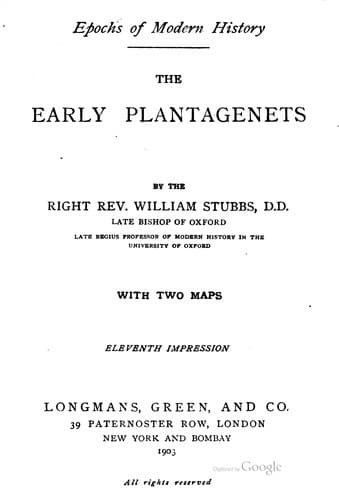
Great Britain -- History -- Plantagenets, 1154-1399; Plantagenet, House of
But the very moment that closes the ecclesiastical quarrel begins a
new one--the baronial quarrel, which opens the way for the vindication
of national liberty and the consolidation of constitutional life, as
typified by Magna Carta. To realize this we must glance back for a
moment to the beginning of the reign, and recur to the negotiations
which Archbishop Hubert had had with the earls before he obtained their
consent to receive John as king, and the promise he had made that all
their lawful demands should be satisfied. What those demands were we
cannot tell exactly; probably they wanted the custody of their own
castles and some other privileges of which they had been deprived by
the strong government of the late king, for he had no doubt availed
himself of every plea to restrict their forest privileges and perhaps
to extend the royal right of wardship. It is from Magna Carta itself,
rather than from the historians who have told the story, that we gather
the nature of their grievances. The promises made at Northampton in
1199 had never been fulfilled; in 1201, when the earls repeated their
demands, John replied by laying his hands on their castles and by
compelling them to surrender their heirs as pledges of their good
behaviour. Matters had after that gone on from bad to worse. Not
content with insisting on the feudal service of the knights, he had
increased the rate of carucage and scutage, the two great imposts that
affected the land, and multiplied the occasions of the exaction. Year
after year he had collected his forces as if for a French war, had
brought them to the coast at great expense, and then exacted money
from the barons as the price of their discharge. He had not led them
to battle; he had let Normandy fall out of his hands, he had spoiled
them and put them to shame, implicating them in his own cowardice.
Year after year taxation increased, whilst the king and the kingdom
became more really helpless; for all Englishmen hated his hosts of
mercenaries, and distrusted his project of creating a fleet which, far
more than any national army would be at his own absolute disposal.
And this went on until, in 1207, he began to plunder the clergy, thus
giving a respite to the people and the barons. Whilst the king could
maintain himself by confiscation and plunder of the clergy he abstained
from confiscation and plunder of the laity; and this partly accounts
for the equanimity with which the interdict was borne. Men acquiesced
in the loss of their religious rights so long as they were in a manner
compensated by immunity from taxation. The interdict, too, paralyzed
national action. John was unable to conduct anything like a great
war as long as that blight lay upon the land; he could attack Wales
or Ireland or Scotland, but he could not attack France, under the
circumstances; and he was not by any means idle now, what few military
successes he did achieve being won against the Irish. For the nation
Public-domain text, read in full here on John Shaqi.
Reviews
Reviews
No reviews yet
Be the first to share your thoughts on this work.
Elsewhere in the archive
Join the Discussion
Join the discussion
Sign in to leave a comment or review.
Sign InorCreate an account