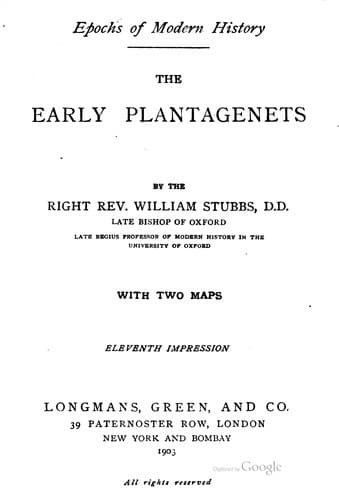
Great Britain -- History -- Plantagenets, 1154-1399; Plantagenet, House of
The reign of Henry III. is not only one of the longest but one of the
most difficult in English history. It contains more than one great
crisis, and coincides in time with an epoch of vast progress; but the
critical importance is by no means equally diffused, and the rate and
fashion of the progress are matter for minute study, rather than for
vivid illustration. The reign covers more than half of one of the most
eventful and brilliant centuries of the world’s history; a century
made famous by the actions of some of the greatest sovereigns, the
most illustrious scholars, the wisest statesmen; the most noble period
of architecture; the last act of the Crusades, the last struggle of
the Papacy with the yet undiminished strength of the Empire. The life
which, on the Continent, runs in these streams is not without its
purpose in England.
[Sidenote:
Character of
Henry III.
]
England also looks on the thirteenth century as her great architectural
age, the age of her great lawyers and some of her greatest divines.
She also has her weight in European affairs, her struggles with the
Papacy, her attempts at sound government. But the real interest of
English history lies in minute constitutional steps of progress, which
are to be estimated rather by their later and united effects, than by
the actual and momentary appearance of growth. For during this time,
England has no guiding or presiding genius. Her king is a man by no
means devoid of all the picturesque qualities of his forefathers, and
possessed of some negatively good qualities which they had not; but on
the whole a degenerate son of such great ancestors, degenerate from
their strength and virtues as well as from their faults and vices.
Henry III. is perhaps a better husband and father, a more devout man,
than any of his predecessors; he is not personally cruel or regardless
of human life; he has no passion for war, no insatiable greed for the
acquisition of territory, such as in the case of his ancestors had
cost so much bloodshed. He is content for the most part to be king of
England, and his success in retaining some part of his Continental
dominion, is the result far more of the honesty of his adversary than
of any ambition, skill, or force of his own. In these respects, England
might have been expected to fare better under Henry, than she had done
under John or Richard or Henry II.; better even than she was to fare
under Edward I.; yet she can scarcely, even viewed in the results, be
said to have done so. The long reign was a long period of trouble,
suffering, and disquietude of every sort. We have no reason to suppose
that Henry was deficient in personal courage, or in skill in arms,
such as a brave knight might possess without being a great captain
in fieldwork or in sieges; or that he was wanting in the desire to
be thought a splendid and magnificent sovereign--as, indeed, he was
thought--for he reaped the advantages of the political position which
Henry II.
Public-domain text, read in full here on John Shaqi.
Reviews
Reviews
No reviews yet
Be the first to share your thoughts on this work.
Elsewhere in the archive
Join the Discussion
Join the discussion
Sign in to leave a comment or review.
Sign InorCreate an account