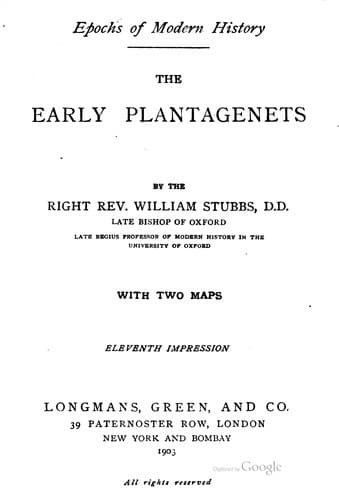
Great Britain -- History -- Plantagenets, 1154-1399; Plantagenet, House of
Edward, with all his faults, had been a kind husband and father;
but he had trusted his wife less implicitly than she desired to be
trusted. In this he was justified by the fact of her close relationship
to the Earl of Lancaster, and still more by the jealousy which she
displayed towards his confidential ministers. Not only the Despensers
but Stapleton, Bishop of Exeter, the Treasurer, and Baldock, the
Chancellor, were the objects of her settled aversion; and she lent a
ready ear to all who fancied that these men had injured them or stood
in the way of their advancement. The court contained many such men, who
were ambitious of becoming ministers of state or bishops and ready to
take either side for gain; men who hated the Despensers, and who saw
their own prospects blighted by the fall of Lancaster. Regularly, as
the tide had turned, as the king or the Ordainers had gained or lost,
the great offices of state had changed hands, and there was all the
grudging, all the personal animosities, which in later ages appear to
be inseparable from government by party.
[Sidenote:
Avarice and
arrogance
of the Despensers.
]
The events which followed the peace with Scotland brought these
influences more strongly into play. The shadows gathered rapidly round
the miserable king almost from that hour. The constitutional struggle
had ceased. The death of the Earl of Lancaster had rid the Despensers
of their most dangerous rival, the revocation of the Ordinances had
left the government in their hands, and the death of the Earl of
Pembroke in 1324 left them without competitors. The elder Hugh, now
made Earl of Winchester, set no limit to his acquisitiveness; he was
an old man, and might have considered that it would be more conducive
to his son’s welfare to make friends than to multiply estates. The
younger Hugh, himself a man of mature years, was made, by his violence
and pride, even more conspicuous than his father. Henry of Lancaster,
the brother and heir of Earl Thomas, was reduced to practical
insignificance by the detention of his brother’s estates in the king’s
hands; and although the Despensers sought to purchase his services, and
he had no personal dislike to the king, he could not be regarded as a
safe and sound pillar of the falling state. The ministers Baldock and
Stapleton were faithful men, but neither wise enough to counteract nor
strong enough to guide the policy of the favorites.
[Sidenote:
Summons
to Edward
to do
homage to
the new
French
king.
]
[Sidenote:
Departure
of the queen
for France,
followed by
that of
Prince
Edward.
]
Public-domain text, read in full here on John Shaqi.
Reviews
Reviews
No reviews yet
Be the first to share your thoughts on this work.
Elsewhere in the archive
Join the Discussion
Join the discussion
Sign in to leave a comment or review.
Sign InorCreate an account