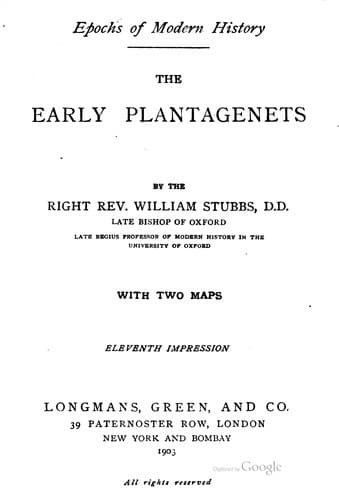
Great Britain -- History -- Plantagenets, 1154-1399; Plantagenet, House of
Edward knew all this, but he knew not how to meet it. In vain he
summoned parliaments that would do nothing when they met, and ordered
musters that would not meet at all. He found that all whom he trusted
deceived him; that, except the Despensers and the two detested
ministers, none even pretended to support him; and that he was obliged
to depend on the very men who had the most to avenge. At last Isabella
landed, on September, 24, 1326, on the coast of Suffolk, proclaiming
herself the avenger of the blood of Lancaster and the sworn foe of the
favorites. Edward, who was in London, tried to obtain help from the
citizens, and prevailed on the bishops to excommunicate the invaders.
But early in October he fled into the West, where he thought the
Despensers were strong; on the 15th the Londoners rose and murdered
the treasurer; Archbishop Reynolds retired into Kent and began to make
terms with the queen.
[Sidenote:
Triumphant
march of Isabella
to the
West of England.
]
[Sidenote: Fall of Bristol.]
[Sidenote:
Overthrow and
deposition of
the king.
]
[Sidenote:
Murder of
Edward II.
]
She in the meantime moved on in triumph; Henry of Lancaster, the
king’s brothers, the earls, save Arundel and Warenne, the bishops
almost to a man, joined her either in person or with effective help.
Adam Orlton, the Bishop of Hereford, who had been the confidential
friend of Bohun, and Henry Burghersh, the Bishop of Lincoln, the
nephew of Badlesmere, led the councils of aggression. They advanced
by Oxford to attack Bristol, where they expected to find Edward and
the Earl of Winchester. On October 26 the queen reached Bristol,
but her husband had gone into Wales and was attempting to escape to
Ireland. The capture of Bristol, however, was the closing event of his
reign. The Earl of Winchester was hanged forthwith. The young Edward
was declared by the lords on the spot guardian of the kingdom, and
he summoned a parliament to meet in his father’s absence. The king,
with Hugh le Despenser and Baldock, were taken on November 16; on the
17th the Earl of Arundel was beheaded at Hereford; on the 24th Hugh
le Despenser was hanged, drawn and quartered at the same place. The
parliament was to settle the fate of the king, and the parliament met
at Westminster on January 7. There matters were formally discussed,
but the conclusion was, as all the world knew, foregone. Even if any
had thought that, now that the country was rid of the Despensers, the
king might be allowed to reign on, the dread of the London mob and of
the armed force which Mortimer brought up silenced them. The wretched
archbishop declared that the voice of the people was the voice of God.
Bishop Orlton, professing to believe that if the king were released the
queen’s life would not be safe, insisted that the parliament should
choose between father and son. Bishop Stratford of Winchester, who led
the Lancaster party and had no love for Mortimer, drew the articles
Public-domain text, read in full here on John Shaqi.
Reviews
Reviews
No reviews yet
Be the first to share your thoughts on this work.
Elsewhere in the archive
Join the Discussion
Join the discussion
Sign in to leave a comment or review.
Sign InorCreate an account