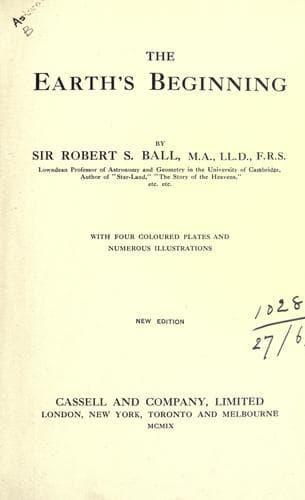
The Earth's BeginningBall, Robert S. (Robert Stawell)
Science
The Earth's Beginning
Ball, Robert S. (Robert Stawell)
Krakatoa (Indonesia); Nebular hypothesis
It follows from these considerations that the rocks which form the
earth’s crust over the surface of the continents and the islands, or
beneath the beds of ocean, must have a lessening acreage year by year.
These rocks must therefore submit to compression, either continuously or
from time to time, and the necessary yielding of the rocks will in
general take place in those regions where the materials of the earth’s
crust happen to have comparatively small powers of resistance. The acts
of compression will often, and perhaps generally, not proceed with
uniformity, but rather with small successive shifts, and even though the
displacements of the rocks in these shifts be actually very small, yet
the pressures to which the rocks are subjected are so vast that a very
small shift may correspond to a very great terrestrial disturbance.
Suppose, for instance, that there is a slight shift in the rocks on each
side of a crack, or fault, at a depth of ten miles. It must be
remembered that the pressure ten miles down would be about thirty-five
tons on the square inch. Even a slight displacement of one extensive
surface over another, the sides being pressed together with a force of
thirty-five tons on the square inch, would be an operation necessarily
accompanied by violence greatly exceeding that which we might expect
from so small a displacement if the forces concerned had been only of
more ordinary magnitude. On account of this great multiplication of the
intensity of the phenomenon, merely a small rearrangement of the rocks
in the crust of the earth, in pursuance of the necessary work of
accommodating its volume to the perpetual shrinkage, might produce an
excessively violent shock extending far and wide. The effect of such a
shock would be propagated in the form of waves through the globe, just
as a violent blow given at one end of a bar of iron by a hammer is
propagated through the bar in the form of waves. When the effect of this
internal adjustment reaches the earth’s surface, it will sometimes be
great enough to be perceptible in the shaking it gives that surface. The
shaking may be so violent that buildings may not be able to withstand
it. Such is the phenomenon of an earthquake.
Public-domain text, read in full here on John Shaqi.
Reviews
Reviews
No reviews yet
Be the first to share your thoughts on this work.
Elsewhere in the archive
Join the Discussion
Join the discussion
Sign in to leave a comment or review.
Sign InorCreate an account