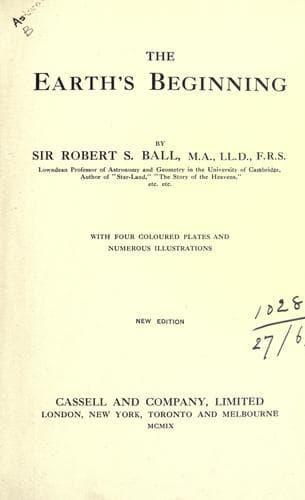
The Earth's BeginningBall, Robert S. (Robert Stawell)
Science
The Earth's Beginning
Ball, Robert S. (Robert Stawell)
Krakatoa (Indonesia); Nebular hypothesis
Let us suppose, for example, that an earthquake occurs in Japan, in
which much agitated country it is, I believe, estimated that no fewer
than one thousand earthquakes of varying degrees of intensity occur
annually in one district or another. Let us suppose that this earthquake
behaves as serious earthquakes usually do; that it knocks down buildings
and monuments, causes landslips, raises great waves in the sea and hurls
them as inundations on the land. We may also suppose that it issues
tragically in the loss of many lives and that there is a destruction of
much property, and that its energies in the acutely violent form extend
over, let us say, an area of a hundred square miles. Beyond that area of
greatest destruction such an earthquake would be felt over a great
extent of country as a shaking more or less vehement, and characteristic
rumbling sounds would be heard. But the intensity declines with the
distance, and we may feel confident that not even the faintest
indications of the earthquake would be perceptible by the unaided senses
at a thousand miles from its origin. A thousand miles is, however, less
than a fifth of the distance between Tokio and Shide, in the Isle of
Wight, measured in a great circle round the earth’s surface. The acutest
sense could not perceive the slightest indication of the convulsion in
Japan at even half the distance between these two places. But the earth
transmits so faithfully the undulations committed to its care that
though the intensity may have declined so as to be no longer perceptible
to the unaided sense, it is still possible that they may be shown
distinctly on the seismometer in Professor Milne’s laboratory, even
after a journey of five thousand miles. This instrument not only
announces that an earthquake has been in progress some little time
previously, but the recording pencil reproduces with marvellous fidelity
some actual details of the vibration. The movements of the line up and
down on the revolving drum of paper show how the convulsions succeed
each other, and their varying intensity. Thus Professor Milne is enabled
to set down some features of the earthquake long before the post brings
an account of the convulsion from the unhappy locality.
Public-domain text, read in full here on John Shaqi.
Reviews
Reviews
No reviews yet
Be the first to share your thoughts on this work.
Elsewhere in the archive
Join the Discussion
Join the discussion
Sign in to leave a comment or review.
Sign InorCreate an account