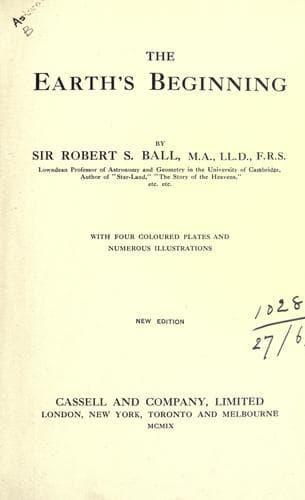
The Earth's BeginningBall, Robert S. (Robert Stawell)
Science
The Earth's Beginning
Ball, Robert S. (Robert Stawell)
Krakatoa (Indonesia); Nebular hypothesis
Let us, then, suppose a single planet revolving round a fixed sun, in
the centre. The energy of this system has two parts. There is first the
energy due to the velocity of the planet, and this is found by taking
half the product of the mass of the planet and the square of its
velocity. The second part of the energy depends, as we have already
explained, on the distance of the planet from the sun. The planet
possesses energy on account of its situation, for the attraction of the
sun on the planet is capable of doing work. The further the planet is
from the sun the larger is the quantity of energy that it possesses from
this cause. On the other hand, the further the planet is from the sun
the smaller is its velocity, and the less is the quantity of energy that
it possesses of the first kind. We unite the two parts, and we find that
the net result may be expressed in the following manner: If a planet be
revolving in a circular path round the sun, then the total energy of
that system (apart from any rotation of the sun and planet on their
axes), when added to the reciprocal of the distance between the two
bodies, measured with a proper unit of length, is the same for all
distances of the same two bodies. This shows the connection between the
energy and the distance of the planet from the sun.
Thus we see that if the circle is enlarged the energy of the system
increases. The moment of momentum of the system is proportional to the
square root of the distance of the two bodies. If, therefore, the
distance of the two bodies is increased, the moment of momentum
increases also.
Public-domain text, read in full here on John Shaqi.
Reviews
Reviews
No reviews yet
Be the first to share your thoughts on this work.
Elsewhere in the archive
Join the Discussion
Join the discussion
Sign in to leave a comment or review.
Sign InorCreate an account