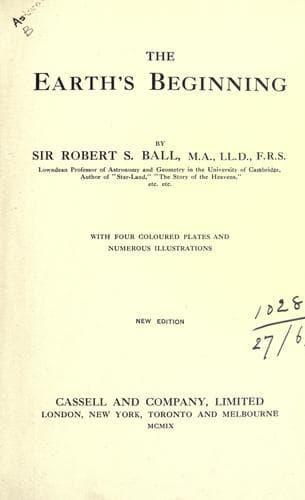
The Earth's BeginningBall, Robert S. (Robert Stawell)
Science
The Earth's Beginning
Ball, Robert S. (Robert Stawell)
Krakatoa (Indonesia); Nebular hypothesis
Think of the rocks which form the earth’s crust and of the minerals
which lie far below. Think of the soil which lies on its surface, of the
forests which that soil supports, and the crops which it brings forth.
Think of the waters of the ocean, and the ice of the Poles. Think of the
objects of every kind on this globe. Think of the stone walls of a great
building, of the iron used to give it strength, of the slates which
cover it, and of the timber which forms its floors; think of the
innumerable other materials which have gone towards its construction;
think even of the elementary substances which go to form the bodies of
animals, of the lime in their bones, and of the carbon which is so
intimately associated with life itself. The nebular theory declares that
those materials have not always been in the condition in which we now
see them; that there was a time in which they were so hot that they were
not in the solid state; they were not even in the fluid state, but were
all in rolling volumes of glowing vapour which formed the great primæval
fire-cloud.
We must understand the composite nature of the primitive fire-mist from
which our solar system originated. Let me illustrate the matter thus: We
shall suppose that a heterogeneous collection of substances is brought
together, the items of which may be somewhat as follows: let there be
many tons of iron and barrels of lime, some pieces of timber, and
cargoes of flint; let there be lead and tin and zinc, and many other
metals, from which copper and silver and several of the rarest metals
must not be excluded; let there be innumerable loads of clay, which
shall represent aluminium and silicon, and hogsheads of sea-water to
supply oxygen, hydrogen, and sodium. There should be also, I need hardly
add, many other elements; but there is no occasion to mention more;
indeed, it would be impossible to give a list which would be complete.
Public-domain text, read in full here on John Shaqi.
Reviews
Reviews
No reviews yet
Be the first to share your thoughts on this work.
Elsewhere in the archive
Join the Discussion
Join the discussion
Sign in to leave a comment or review.
Sign InorCreate an account