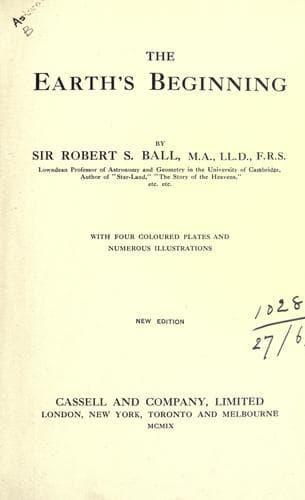
The Earth's BeginningBall, Robert S. (Robert Stawell)
Science
The Earth's Beginning
Ball, Robert S. (Robert Stawell)
Krakatoa (Indonesia); Nebular hypothesis
Perhaps the most astonishing discovery made in modern times about the
sun is connected with the wonderful element, helium. So long ago as 1868
Sir Norman Lockyer discovered, during an eclipse, that the light of the
sun contained evidence of the presence in that orb of some element which
was then totally unknown to chemists. This new body was not unnaturally
named the sun-element, or helium. But more than a quarter of a century
had to elapse before any chemist could enjoy the opportunity of
experimenting directly upon helium. No labour could prepare the smallest
particle of this substance, no money could purchase it, for at that time
no specimen of the element was known to exist nearer than the sun,
ninety-three million miles distant. But in 1895 an astonishing discovery
was made by Professor Ramsay. He was examining a rare piece of mineral
from Norway. From this mineral, clevite, the Professor extracted a
little gas which was to him and to all other chemists quite unknown. But
on applying the spectroscope to examine the character of the light which
this gas emitted when submitted to the electric current, it yielded, to
their amazement, the characteristic light of helium. Thus was the
sun-element at last shown to be a terrestrial body, though no doubt a
rare one. The circumstances that I have mentioned make helium for ever
famous among the constituents of the universe. It will never be
forgotten that though from henceforth it may be regarded as a
terrestrial body, yet it was first discovered, not in the earth beneath
our feet, but in the far-distant sun.
Public-domain text, read in full here on John Shaqi.
Reviews
Reviews
No reviews yet
Be the first to share your thoughts on this work.
Elsewhere in the archive
Join the Discussion
Join the discussion
Sign in to leave a comment or review.
Sign InorCreate an account