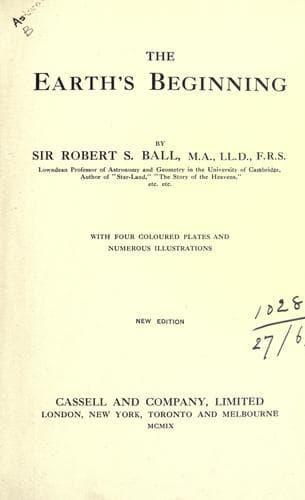
The Earth's BeginningBall, Robert S. (Robert Stawell)
Science
The Earth's Beginning
Ball, Robert S. (Robert Stawell)
Krakatoa (Indonesia); Nebular hypothesis
Rotations of the Planets on their Axes.—The Older Planets—No Information
about Uranus or Neptune or the Asteroids—The Speed of Rotation is
Arbitrary so far as Kepler’s Laws are concerned—The Third Concord—A
Remarkable Unanimity—Kant’s Argument—Illustration of the Rotation of
the Moon on its Axis—How the Nebular Theory explains the
Rotation—The Moon’s Evolution—Special Action of Tides—The Evolution
of the other Satellites—The case of Mars—Jupiter and Saturn as
Miniatures of the Solar System—Uranus and Neptune offer
Difficulties.
WE have seen in the last chapter how the rotation of the sun beat time,
as it were, for the planets, by giving to them an indication of the
direction in which the revolutions round the sun should be performed,
and we have observed with what marvellous unanimity the planets follow
the precept thus given. We have now to consider yet another concord,
which has perhaps not the great numerical strength of that last
considered, but is, nevertheless, worthy of our most special attention.
The earth revolves about an axis which is not very far from being
perpendicular to the principal plane to which the movements of the solar
system are related. From a dynamical point of view it would, of course,
have been equally possible for the earth to revolve on its axis in the
same direction as the rotation of the sun, or in the opposite direction.
There is nothing so far as the welfare of man is concerned to make one
direction of rotation preferable to the other, but, as a matter of fact,
the earth does turn round in the same way as the sun turns.
Public-domain text, read in full here on John Shaqi.
Reviews
Reviews
No reviews yet
Be the first to share your thoughts on this work.
Elsewhere in the archive
Join the Discussion
Join the discussion
Sign in to leave a comment or review.
Sign InorCreate an account