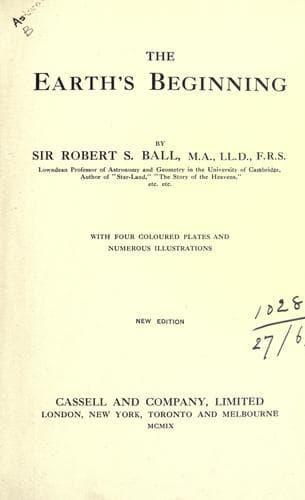
The Earth's BeginningBall, Robert S. (Robert Stawell)
Science
The Earth's Beginning
Ball, Robert S. (Robert Stawell)
Krakatoa (Indonesia); Nebular hypothesis
IT is not difficult to show that the nebular theory occupies a unique
position among other speculations of the human intellect. It is so
comprehensive that almost every conceivable topic will bear some
relation to it. Perhaps I may venture to give a rather curious
illustration of this fact, which was told me many years ago by one who
attended a course of lectures by an eminent Professor in the medical
faculty at, let us say, Vienna. The subject of the course was the no
doubt highly important, but possibly not generally interesting, subject
of “inflammation.” I think I am right in saying that the course had to
last for six months, because the subject was to be treated with
characteristic breadth and profundity. At all events, I distinctly
remember that the learned Professor commenced his long series of
professional discourses with an account of the nebular theory, and from
that starting point he gradually evolved the sequence of events which
ultimately culminated in—inflammation!
It may be remembered that in the year 1880, Professor Huxley delivered
at the Royal Institution a famous lecture which he termed “The Coming of
Age of the Origin of Species.” Among the many remarkable and forcible
illustrations which this lecture contained, I recall one which brought
before the audience, in the most convincing manner, the truth of the
great Darwinian Theory of Evolution. Huxley pointed out how the
discoveries in Biology, during the twenty-one years which immediately
succeeded the publication of the “Origin of Species,” had been so
numerous and so important, and had a bearing so remarkable on the great
evolutionary theory, that even if the Darwinian Theory had not been
formed to explain the facts of Nature, as they were known at the time
when Darwin published his immortal book, the same theory would have had
to be formed, were it only to explain the additional facts which had
come to light since the great theory itself had been first given to the
world.
I believe we may use similar language with regard to the nebular theory
and its great founders, Kant, Laplace, and Herschel. If the facts which
were known to these philosophers led them to adopt in one form or
another that view of the Origin of the Universe which the nebular theory
suggests, how stands the theory now in the light of the additional facts
that have been since disclosed? If we merely took the discoveries which
have been made since the last of the three great philosophers passed
away, it might well be maintained that a nebular theory would be
demanded to account for the facts brought to light, in the interval.
Public-domain text, read in full here on John Shaqi.
Reviews
Reviews
No reviews yet
Be the first to share your thoughts on this work.
Elsewhere in the archive
Join the Discussion
Join the discussion
Sign in to leave a comment or review.
Sign InorCreate an account