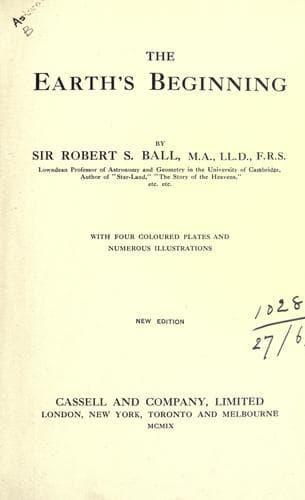
The Earth's BeginningBall, Robert S. (Robert Stawell)
Science
The Earth's Beginning
Ball, Robert S. (Robert Stawell)
Krakatoa (Indonesia); Nebular hypothesis
This important theorem is deduced from the fact stated in the third law
of motion, that action and reaction are equal and opposite. Let us take
any two particles; then, the acceleration of the moment of momentum of
one of them, A, by the action of the other, B, will be the moment of the
force between them. The acceleration of the moment of momentum of B by
the action of A will be the same moment, but with an opposite sign.
Hence the total acceleration of the moment of momentum of the system by
the mutual action of A and B is zero. In like manner we dispose of every
other pair of actions, and thus, as the total acceleration of the moment
of momentum is zero, it follows that the moment of momentum of the
system itself must be constant.
This fundamental principle is also known as the doctrine of the
conservation of areas. It may be stated in the following manner:—
_If a system of particles are moving in a plane under the influence of
their mutual actions only, the algebraic sum of the areas swept out
around a point, each multiplied by the mass of the particle, is directly
proportional to the time._
§ 13. IF A PARTICLE OF MASS _m_, IS MOVING IN SPACE UNDER THE ACTION OF
ANY FORCE F, THEN THE PROJECTION OF THAT PARTICLE ON ANY FIXED PLANE
WILL MOVE AS IF IT WERE A PARTICLE OF MASS _m_ ACTED UPON BY THAT
COMPONENT OF F WHICH IS PARALLEL TO THE PLANE.
This is evident from the consideration that the acceleration of the
particle parallel to the plane must be proportional to this component of
F.
Let us now suppose a system of particles moving in space under their
mutual actions. The projections of these particles on a plane will move
as if they were the particles themselves subjected to the action of
forces which are the projections of the actual forces on the same plane,
and as the reactions between any two particles are equal and opposite,
the projections of those reactions on the plane are equal and opposite.
Hence the proof already given of the constancy of the moments of
momentum of a plane system, will apply equally to prove the constancy of
the moments of momentum of the projections of the particles on the
plane. Hence we have the following important theorem:—
_Let a system of particles be moving in space under the action of forces
internal to the system only. Let any plane be taken, and any point in
that plane, and let the momentum of each particle be projected into the
plane, then the algebraic sum of the moments of these projections around
the point is constant._
§ 14. ON THE PRINCIPAL PLANE OF A SYSTEM.
Public-domain text, read in full here on John Shaqi.
Reviews
Reviews
No reviews yet
Be the first to share your thoughts on this work.
Elsewhere in the archive
Join the Discussion
Join the discussion
Sign in to leave a comment or review.
Sign InorCreate an account