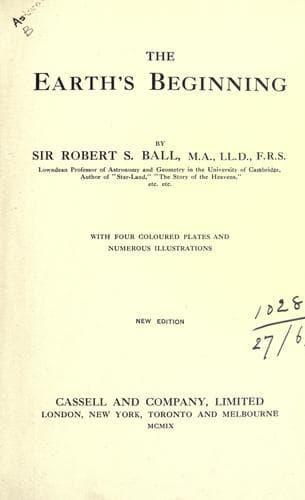
The Earth's BeginningBall, Robert S. (Robert Stawell)
Science
The Earth's Beginning
Ball, Robert S. (Robert Stawell)
Krakatoa (Indonesia); Nebular hypothesis
another is brought up for examination. These cores, when ranged in
series, give to the miner the information he requires as to the
different beds of rock through which the instrument has pierced in its
descent and as to the depths of the beds. A series of cores will
sometimes show astonishing variety in the material through which the
drill has passed. Here the tool will be seen passing through a bed of
hard limestone, and then entering a bed of soft shale; now the tool
bores through dense and hard masses of greenstone, anon it pierces, it
may be, a stratum of white marble; and finally the explorer may hope to
find his expectations realised by the arrival at the surface of a
cylinder of solid coal.
The famous boring to which we are now referring, though very deep, was
not large in diameter. As it descended the comparatively large tool
first employed was replaced by a succession of smaller tools, so that
the hole gradually tapered from the surface to the lowest point. At its
greatest depth the hole was indeed hardly larger than a man’s little
finger. It increased gradually all the way to the surface, where it was
large enough for a man’s arm to enter it easily.
How often do we find that the success which rewards mechanical
enterprise greatly transcends even the most sanguine estimate previously
formed! Without the actual experience which has been acquired, I do not
think anyone could have anticipated the extraordinary facilities which
the diamond drill has given in the operations of a deep boring. This
hole at Schladebach was, indeed, a wonderful success. It pierced deeper
than any previous excavation, deeper than any well, deeper than any coal
pit. From the surface of the ground, where the hole was some six inches
in diameter, down to the lowest point, where it was only as large as a
little finger, the vertical depth was not less than one mile and a
hundred and seventeen yards.
Public-domain text, read in full here on John Shaqi.
Reviews
Reviews
No reviews yet
Be the first to share your thoughts on this work.
Elsewhere in the archive
Join the Discussion
Join the discussion
Sign in to leave a comment or review.
Sign InorCreate an account