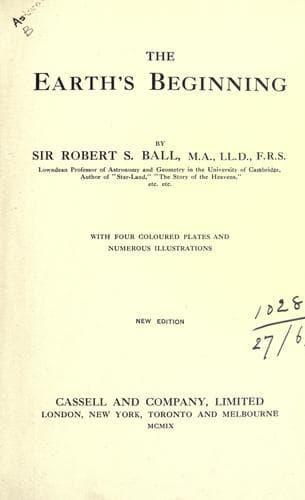
The Earth's BeginningBall, Robert S. (Robert Stawell)
Science
The Earth's Beginning
Ball, Robert S. (Robert Stawell)
Krakatoa (Indonesia); Nebular hypothesis
I need not specify the details of the arrangements which enabled the
skilful engineer also to determine the temperature at various points of
the hole intermediate between the top and the bottom. In fact, taking
every precaution to secure accuracy, he made measurements of the
temperature at a succession of points about a hundred feet distant
throughout the whole depth. In each case he was careful, as I have
already indicated, to plug the hole above and below the thermometer, so
as to prevent the circulation of water in the vicinity of the
instrument. The thermometer, therefore, recorded the temperature of the
surrounding rocks without any disturbing element. Fifty-eight
measurements at equal distances from the surface to the greatest depths
were thus obtained.
We have now to discuss the instructive results to which we have been
conducted by this remarkable series of measurements. First let us notice
that there is much less variation in the subterranean temperatures than
in the temperatures on the earth’s surface. On the surface of the earth
we are accustomed to large fluctuations of temperature. We have, of
course, the diurnal fluctuations in temperature from day to night; we
have also the great seasonal fluctuations between summer and winter. But
below a certain depth in the ground the temperature becomes much more
equable. Whether the temperature on the surface be high or whether it be
low, the temperature of any particular point far beneath the surface
does not change to any appreciable extent. In Arctic regions the surface
of the earth may undergo violent seasonal changes of temperature, while
at a few feet below the surface the temperature, from one end of the
year to the other, may remain sensibly unaltered.
In deep and extensive caverns the temperature is sometimes found to
remain practically unaffected by the changes in the seasons. The Mammoth
Cave of Kentucky is a notable instance. The uniformity of the
temperature, as well as the mildness and dryness of the air, in those
wonderful subterranean vaults is such that many years ago a project was
formed to utilise the cavern as an abode for consumptive patients, for
whose cure, according to the belief then prevailing, an equable
temperature was above all things to be desired. Houses were indeed
actually built on the sandy floors of the cavern, and I believe they
were for some time tenanted by consumptive patients willing to try this
desperate remedy. The temperature may have been uniform and the air may
have been dry, but the intolerable gloom of such a residence entirely
neutralised any beneficial effects that might otherwise have accrued.
The ruins of the houses still remain to testify to the failure of the
experiment.
Public-domain text, read in full here on John Shaqi.
Reviews
Reviews
No reviews yet
Be the first to share your thoughts on this work.
Elsewhere in the archive
Join the Discussion
Join the discussion
Sign in to leave a comment or review.
Sign InorCreate an account