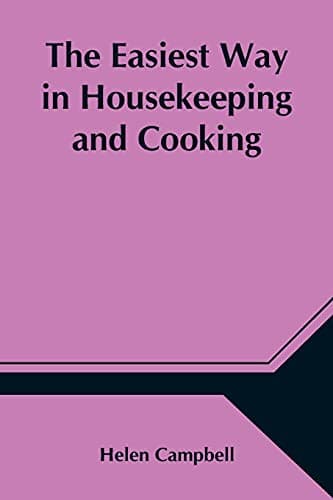
The Easiest Way in Housekeeping and Cooking: Adapted to Domestic Use or Study in ClassesCampbell, Helen
General
The Easiest Way in Housekeeping and Cooking: Adapted to Domestic Use or Study in Classes
Campbell, Helen
Cooking; Home economics
In many cases physicians who have studied the laws of food, and kept pace
with modern experiments in dietetics, strike out meat altogether till the
child is seven or eight years old, and allow it but once daily after this
time, and in very limited amount. Sir Henry Thompson, one of the most
distinguished of English physicians, and a man noted for his popularity as
diner out and giver of dinners, writes strenuously against the prevailing
excessive use of meat, and especially protests against its over use for
children; and his opinion is shared by most thoughtful medical men. The
nitrogenous vegetables advantageously take its place; and cheese, as
prepared after the formulas given in Mattieu Williams's "Chemistry of
Cookery," is a food the value of which we are but just beginning to
appreciate.
As to quantity, with the healthy child, playing at will, there need be
very little restraint. Few children will eat too much of perfectly simple
food, such as this table includes. Let cake or pastry or sweetmeats enter
in, and of course, as long as the thing tastes good, the child will beg
for more. English children are confined to this simple diet; and though of
course a less exacting climate has much to do with the greater
healthfulness of the English than the American people, the plain but
hearty and regular diet of childhood has far more.
Our young American of seven, at a hotel breakfast, would call for coffee
and ham and eggs and sausages and hot cakes. His English cousin would have
no liberty to call for anything. In fact, it is very doubtful if he would
be brought to table at all; and if there, bread and milk or oatmeal and
milk would form his meal.
By this time I do not doubt our baby has your heartiest pity, and you are
saying, "What! no snacks? no cooky nor cake nor candy? no running to aunt
or grandmother or tender-hearted cook for goodies? If that must be so,
half the pleasure of childhood is lost."
Perhaps; but suppose that with that pleasure some other things are also
lost. Suppose our baby to have begun life with a nervous, irritable,
sensitive organization, keenly alive to pain, and this hard regimen to
have covered these nerves with firm flesh, and filled the veins with
clean, healthy blood. Suppose headache is unknown, and loss of appetite,
and a bad taste in the mouth, and all the evils we know so well; and that
work and play are easy, and food of the simplest eaten with solid
satisfaction. The child would choose the pleasant taste, and let health
go, naturally; for a child has small reason, and life must be ordered for
it. But if the mother or father has no sense or understanding of the laws
of food, it is useless to hope for the wholesome results that under the
diet of our baby are sure to follow.
Public-domain text, read in full here on John Shaqi.
Reviews
Reviews
No reviews yet
Be the first to share your thoughts on this work.
Join the Discussion
Join the discussion
Sign in to leave a comment or review.
Sign InorCreate an account