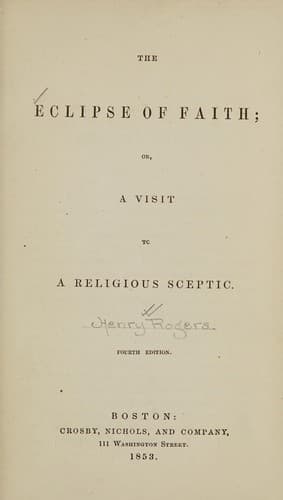
The Eclipse of Faith; Or, A Visit to a Religious ScepticRogers, Henry
Religion
The Eclipse of Faith; Or, A Visit to a Religious Sceptic
Rogers, Henry
Skepticism -- Controversial literature
Under the same head will be included the grotesque
devil-stories and other legends of the Middle Ages ...... Yet the
dreadful alternative of gross superstition is this, that the graver
view tends to cruel and horrible rites, while the fanciful and
sportive sucks out the life-blood of devout feeling." (Ibid. pp. 14-16.)
Then comes the sense of beauty: "This was strikingly illustrated in
Greek sculpture. A statue of exquisite beauty, representing some hero,
or an Apollo, because of its beauty, seemed to the Greeks a fit object
of worship ...... An opposite danger is often remarked to accompany
the use of all the fine arts as handmaids to religion; namely, that
the would-be worshipper is so absorbed in mere beauty as never to
rise into devotion." (Ibid. pp. 21, 23.) Then comes the sense of
order; but, alas! Atheism and Pantheism, and other "degrading types,"
may be begotten of it!
As I look at men thus tumbling into error along this wretched
causeway to heaven, I seem to be viewing Addison's bridge of human
life, with its broken arches, at each of which thousands are falling
through. This way to the "celestial city" ought to be called the
"Northwest Passage"; it has one, and only one, trait of your
Christian path: "there will be few that find it."
If, then, by the confession of these writers, the "false conceptions"
and the "degraded types"--the result of what are as truly "principles"
of man's nature as the supposed "spiritual faculty," only that this
last always has the worst in the conflict--have universally, and
for unknown ages, involved man in the darkest abysses of superstition,
crime, and misery, surely external revelation is any thing but
superfluous; and if impossible, so much the worse.
The same truth is even formally evinced by the self-destructive
course which both writers employ; for as the conditions of the
development of our "spiritual nature," when not complied with,
lead to all the deplorable consequences which they acknowledge,
how do they propose to rectify them? Why, by "external"
culture, proper discipline and training, judicious instruction,
by enlightening mankind,--as we may suppose they are doing by these
hopeful books of theirs! If man can do so much by his books, is
it impossible that a book from God might do something more? But
on this I will say nothing, since you tell me that you have heard
attentively the conversation I had with my friend Fellowes the other
day. I will therefore omit what I had written on this point ......
Public-domain text, read in full here on John Shaqi.
Reviews
Reviews
No reviews yet
Be the first to share your thoughts on this work.
Elsewhere in the archive
Join the Discussion
Join the discussion
Sign in to leave a comment or review.
Sign InorCreate an account