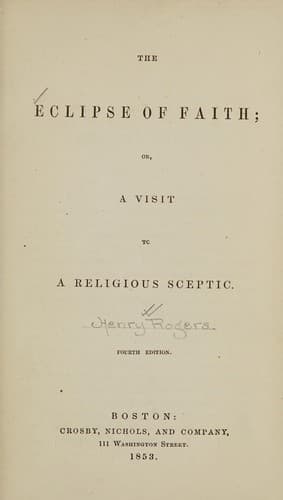
The Eclipse of Faith; Or, A Visit to a Religious ScepticRogers, Henry
Religion
The Eclipse of Faith; Or, A Visit to a Religious Sceptic
Rogers, Henry
Skepticism -- Controversial literature
But, however these things may be, I now proceed to what I acknowledge
is the most weighty topic of my argument; which is to prove that, if
I acquiesce, on Mr. Newman's grounds, in the rejection of the Bible
as a special revelation of God, I am compelled on the very same
principles to go a few steps further, and to express doubts of the
absolutely divine original of the World, and the administration
thereof, just as he does of the divine original of the Bible. If I
concede to Mr. Newman, however we may differ as to the moral and
spiritual faculties of man, that these are yet the sole and ultimate
court of appeal to us; that from our "intuitions" of right and wrong,
of "moral and spiritual, truth," be they more perfect according to him,
or more rudimentary and imperfect according to me, we must form a
judgment of the moral bearings of every presumed external revelation
of God,--I cannot do otherwise than reject much of the revelation of
God in his presumed Works as unworthy of him, just as Mr. Newman
does very much in his supposed Word as equally unworthy of him. Mr.
Newman says, "Only by discerning that God has Virtues, similar in kind
to human Virtues, do we know of his truthfulness and his goodness......
The nature of the case implies, that the human mind is competent to sit
in moral and spiritual judgment on a professed revelation, and to decide
(if the case seem to require it) in the following tone:--'This doctrine
attributes to God that which we should all call harsh, cruel, or unjust
in man: it is therefore intrinsically inadmissible; for if God may be
(what we should call) cruel, he may equally well be (what we should
call) a liar; and, if so, of what use is his word to us?'" (Soul, p. 58)
Similarly Mr. Newman continually affirms that God reveals himself,
when he reveals himself at all, within, and not without; as he says
in his "Phases,"--"Of our moral and spiritual God we know nothing
without,--every thing within. It is in the spirit that we meet him
not in the communications of sense." (p. 52.) If I acquiesce in this
judgment, I must apply the reasoning of the above passage to the
"external revelation" of God in his Works, as well as to that in
his Word; and the above reasoning will be equally valid, merely
substituting one word for the other. We are to decide, if the case
seem to require it, in the following tone:--"These phenomena--this
conduct--implies what we should call in man harsh, or cruel, or
unjust; it is, therefore, intrinsically inadmissible as God's work
or God's conduct."
Public-domain text, read in full here on John Shaqi.
Reviews
Reviews
No reviews yet
Be the first to share your thoughts on this work.
Elsewhere in the archive
Join the Discussion
Join the discussion
Sign in to leave a comment or review.
Sign InorCreate an account