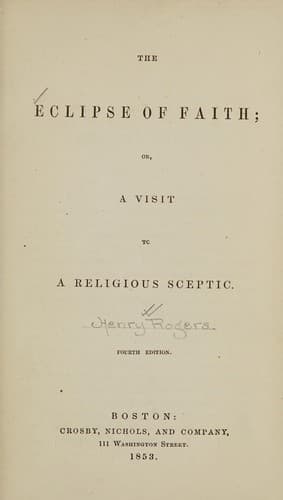
The Eclipse of Faith; Or, A Visit to a Religious ScepticRogers, Henry
Religion
The Eclipse of Faith; Or, A Visit to a Religious Sceptic
Rogers, Henry
Skepticism -- Controversial literature
"Absurd be it," said Harrington, "only be so kind as to show it to be
so, instead of saying so. I maintain that the one class of facts are
just as 'inexplicable,' as you call it, as the other, and only appear
otherwise because, in the one case, we daily see them, have become
accustomed to them and, what is more than all, cannot deny them,--which
last we can so promptly do in the other case; for Moses is not here to
contradict us. But I rather think, that a being constituted morally
and intellectually like us, who had never known any but a world of
happiness, would just as promptly deny that God could ever perform
such feats as are daily performed in this world! I repeat, that, if
for some reasons ('inexplicable,' I grant you) God does not mind
doing such things, he is not likely to hesitate to enjoin them; for
reasons perhaps equally inexplicable. I say perhaps; for, as I
compare such an event as the earthquake in Lisbon, or the plague in
London, with the extermination of the Canaanites, I solemnly assure
you that I find a greater difficulty, as far as my 'intuitions' go,
in supposing the former event to have been effected by a divine
agency than the latter. If we take the Scripture history, we must at
least allow that the race thus doomed had long tried the patience
of Heaven by their flagrant impiety and unnatural vices; that they
had become a centre and a source (as we sometimes see collections of
men to be) of moral pestilence, in the vicinage of which it was unsafe
for men to dwell; that, as the Scriptures say (whether truly or falsely,
I do not inquire), they had, filled up the measure of their iniquities.'
Let this be supposed as fictitious as you please, still the whole
proceeding is represented as a solemn judicial one; and supposing the
events to have occurred just as they are narrated, it positively seems
to me much less difficult to suppose them to harmonize with the
character of a just and even beneficent being, than those wholesale
butcheries which have desolated the world, in every hour of its long
history, without any discrimination whatever of innocence or guilty;
which, if they have inflicted unspeakable miseries on the immediate
victims, have produced probably as much or more in the agony of the
myriad myriads of hearts which have bled or broken in unavailing
sorrow over the sufferings they could not relieve. Such things
(I speak now only of what man has not in any sense inflicted) are,
in your view, as undeniably the work of God as is the extermination
of the Canaanites according to the Bible. Why, if God does not mind
doing such things, are we to suppose that he minds on some occasions
ordering them to be done; unless we suppose that man--delicate
creature!--has more refined intuitions of right and wrong, and knows
better what they are, than God himself? Now, Mr. Newman and you
affirm, that to suppose God should have enjoined the destruction of
the Canaanites is a contradiction of our moral intuitions; and that
Public-domain text, read in full here on John Shaqi.
Reviews
Reviews
No reviews yet
Be the first to share your thoughts on this work.
Elsewhere in the archive
Join the Discussion
Join the discussion
Sign in to leave a comment or review.
Sign InorCreate an account