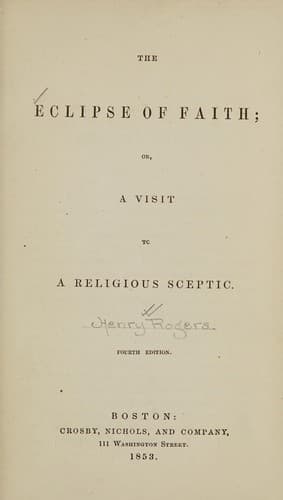
The Eclipse of Faith; Or, A Visit to a Religious ScepticRogers, Henry
Religion
The Eclipse of Faith; Or, A Visit to a Religious Sceptic
Rogers, Henry
Skepticism -- Controversial literature
"My dear uncle," replied Harrington, "you are insufficiently informed
in the mystery of modern theology. There are no atheists, properly
speaking; they who are so called merely deny any personal, conscious,
intelligent sovereign of the universe. Even those who call themselves
so, and will have it that they are so, are told that they are none. I
myself have perused statements of some of our modern 'spiritualists,'
who know every thing, even other people's consciousness quite as
well as their own (and perhaps better), that the said atheists are
mistaken in thinking themselves such; that such genuine love of the
spirit of universal nature is something truly divine, and that they
are animated by 'a deeply religious spirit,' though they never
suspected it!"
"Well," said I. "if you had too much reason, as you flattered yourself
(adopting Hume's criterion), to become an atheist, could you not have
adopted such views as those of Mr. G. Atkinson and Miss Martineau, who
both possess surely (as they claim to possess) that 'religious reverence'
of nature of which you have just spoken?"
"Why," he replied, "I am afraid that, if I had too much reason for
the one, I have not faith enough for the other. That the miracles and
prophecies of the Bible may possibly have been true,--only the effect
of mesmerism;--that things quite as wonderful, or more so, happen
every day by this wonderful agent;--that every phenomenon that takes
place does so in virtue a perfectly wise LAW, without any wise
LAWGIVER;--that this wise law has, it seems, prearranged that man
should generally exhibit an inveterate tendency to religious systems
of some kind, though all religions are absurd, and persist in believing
in his free will, though free from a downright impossibility;--that
these contradictions and absurdities of man are the result of an
irreversible necessity, and yet that Mr. Atkinson may hope to correct
them;--that, by the same necessity, man is in no degree culpable or
responsible, and yet that Mr. Atkinson may perpetually blame him;
--that no man can do any thing 'wrong,' and yet that till he believes
that, man will never cease to do it;--that people may read without
their eyes, and distinguish colors as colors though they are born
blind;--that Bacon was an atheist, and that this may be proved by
induction from his own writings;--these and other paradoxes, which
I must believe, if I believe Mr. Atkinson, require a faith which it
would really be unreasonable to expect from such a sceptic as I am."
____
Public-domain text, read in full here on John Shaqi.
Reviews
Reviews
No reviews yet
Be the first to share your thoughts on this work.
Elsewhere in the archive
Join the Discussion
Join the discussion
Sign in to leave a comment or review.
Sign InorCreate an account