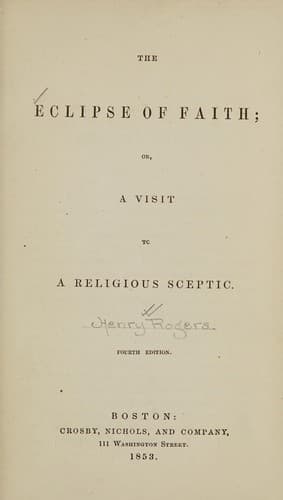
The Eclipse of Faith; Or, A Visit to a Religious ScepticRogers, Henry
Religion
The Eclipse of Faith; Or, A Visit to a Religious Sceptic
Rogers, Henry
Skepticism -- Controversial literature
which he was not inclined to retain there, and each seemed to
substitute in its stead something that he liked better.
Though the assembly was in the main most anxious to come to a right
decision, and really advanced an immense way towards completing a
true and faithful copy of the lost original, the disputes which arose,
on almost every point of theology, promised the world an abundant
crop of new sects and schisms. Already there had sprung up several
whose names had never been heard of in the world, but for this
calamity. Amongst them were two who were called the "Long Memories"
and the "Short Memories." Their general tendencies coincided pretty
much with those of the orthodox and the rationalists.
It was curious to see by what odd associations, sometimes of contrast,
sometimes of resemblance, obscure texts were recovered, though they
were verified, when once mentioned, by the consciousness of hundreds.
One old gentleman, a miser, contributed (and it was all he did contribute)
a maxim of prudence, which he recollected, principally from having
systematically abused it. All the ethical maxims, indeed, were soon
collected; for though, as usual, no one recollected his own peculiar
duties or infirmities, every one, as usual, kindly remembered those
of his neighbors. Husbands remembered what was due from their wives,
and wives what was due from their husbands. The unpleasant sayings
about "better to dwell on the house-top" and "the perpetual dropping
on a very rainy day" were called to mind by thousands. Almost the
whole of Proverbs and Ecclesiastes were contributed, in the merest
fragments, in this way. As for Solomon's "times for every thing," few
could remember them all, but every body remembered some. Undertakers
said there was a "time to mourn," and comedians that there was a
"time to laugh"; young ladies innumerable remembered that there was
a "time to love," and people of all kinds that there was a "time
to hate"; every body knew there was a "time to speak," but a worthy
Quaker reminded them that there was also a "time to keep silence."
Some dry parts of the laws of Moses were recovered by the memory of
jurists, who seemed to have no knowledge whatever of any other parts
of the sacred volume; while in like manner one or two antiquarians
supplied some very difficult genealogical and chronological matters,
in equal ignorance of the moral and spiritual contents of the
Scriptures.
Public-domain text, read in full here on John Shaqi.
Reviews
Reviews
No reviews yet
Be the first to share your thoughts on this work.
Elsewhere in the archive
Join the Discussion
Join the discussion
Sign in to leave a comment or review.
Sign InorCreate an account