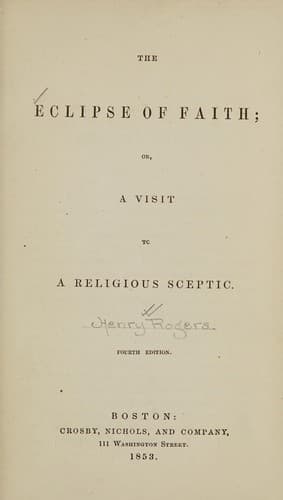
The Eclipse of Faith; Or, A Visit to a Religious ScepticRogers, Henry
Religion
The Eclipse of Faith; Or, A Visit to a Religious Sceptic
Rogers, Henry
Skepticism -- Controversial literature
"And yet," continued Harrington, after a pause, "two or three other
strange consequences seem to follow from that seemingly undeniable
principle on which we base the conclusion that there neither has
been nor can be any such thing as a miracle: in other words, a
departure from the established series of sequences which, as tested
by our own experience and by that of other men, we are convinced is
stable. Will you see with me whether there is any fair mode of
escaping from them? I should be very glad if I could do so."
"What are they?"
"Why, first, I am afraid it must be said, that we must entirely
justify a man in the condition of the Eastern prince mentioned by Hume,
who could not be induced to believe that there was such a thing as ice.
I am afraid that he was quite in the right; and yet we know that in fact
he was wrong."
"You are not, then, satisfied with Hume's own solution?"
"So far from it, that I cannot see, upon the principles on which we
refuse to believe miracles, that it is even intelligible. We agree,
do we not, that, from the experience we have (and, so far as we can
ascertain, from every body else's) of the uniform course of events,
of the established order of sequences, we are to reject any assertion
of a violation of those sequences; as, for example, of a man's coming
into the world in any preternatural manner, or, when he has once gone
out of it, coming into it again; and that we are entitled to do
this without any examination of the witnesses to any such fact,
merely on the strength of the principles aforesaid?"
"I admit that we have agreed to this."
"Now was not the assertion that in a certain quarter of the world
water became solid as stone, could be cut into pieces, and be put
into one's pockets, contrary, in a similar manner, to all the phenomena
which the said prince had witnessed, and also to the uniform experience
of all about him from his earliest years?"
"It certainly was."
"He was right, then, in rejecting the fact; that is, he was right in
rejecting the possibility of such an occurrence," said Harrington.
"But did we not ourselves say, with Hume, that, as we see that there
is not an absolute uniformity in the phenomena of nature, but that
they are varied within certain limits in different climates and
countries, so it does not become us to say that a phenomenon, though
somewhat variable, is a violation of the usual order of sequences?"
Public-domain text, read in full here on John Shaqi.
Reviews
Reviews
No reviews yet
Be the first to share your thoughts on this work.
Elsewhere in the archive
Join the Discussion
Join the discussion
Sign in to leave a comment or review.
Sign InorCreate an account