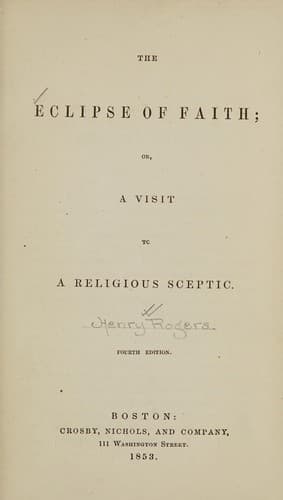
The Eclipse of Faith; Or, A Visit to a Religious ScepticRogers, Henry
Religion
The Eclipse of Faith; Or, A Visit to a Religious Sceptic
Rogers, Henry
Skepticism -- Controversial literature
And this very fact--the unspeakable differences between man and man,
nation and nation, as regards recognition the conscious possession
of even elementary "moral and spiritual truth" (varying, as it
perpetually does, as those external influences vary, and more or
less perfect, according as that external "revelation," which, in
some degree, and of some species, is indispensable, more or less
perfect)--affords another indication of the ample utility of an
external divine revelation, as well as of its possibility; and a
proof that, if there be one, it is in harmony, again, with the
conditions of human nature. And here I may employ, in further
illustration, one of the analogies I adverted to a little time
ago. Not only is the flower never independent of external influences
for its actual development,--not only would it remain in the germ
without them,--but we see that within certain limits, often very wide,
the kind of external influence operates powerfully on the species,
and on the individual itself;--according as it is in one climate
or another,--in this soil or that,--submitted to culture or suffered
to grow wild. It is needless to apply the analogy. While we see
that the moral spiritual faculties of man no more than his other
faculties can attain their development except in cooperation with
some external influences, we also see that they exhibit every degree
and variety of development according to the quality of those external
influences. Is there then not even a possibility left for an external
revelation? If the actual exhibition of any spiritual and religious
phenomena in man not only depends on some external influences and
culture, but perpetually varies with them, what would such a
revelation be but a provision in analogy with these facts? But it is
sufficient to rebut this gratuitous dictum, of an external revelation
of "spiritual and moral truth being impossible," that some external
influence is necessary for any development of the religious faculty
at all. If the last be necessary, I cannot conceive how the other
should be impossible.
Nor is it any reply to say,--as I think has been abundantly shown in
your debates with Harrington,--that any such external influences only
make articulate that which already existed inarticulately in the heart;
that they only chafe and stimulate into life "the ivory of Pygmalion's
statue," to use his expression,--the dormant principles and sentiments
which somehow existed, but were in deep slumber. That which makes them
vital, active, the objects of consciousness and the sources of power,
may well be called a "revelation." Nay, since it seems that, in some
way, this outward voice must be heard first, I think it is more properly
so called than the internal response of the heart. That is rather the echo.
Public-domain text, read in full here on John Shaqi.
Reviews
Reviews
No reviews yet
Be the first to share your thoughts on this work.
Elsewhere in the archive
Join the Discussion
Join the discussion
Sign in to leave a comment or review.
Sign InorCreate an account