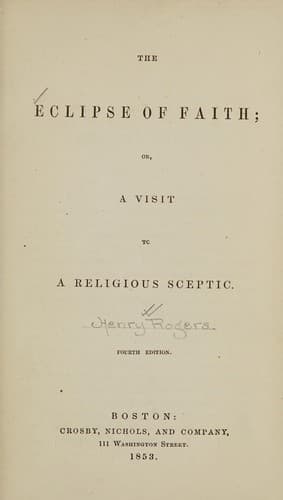
The Eclipse of Faith; Or, A Visit to a Religious ScepticRogers, Henry
Religion
The Eclipse of Faith; Or, A Visit to a Religious Sceptic
Rogers, Henry
Skepticism -- Controversial literature
Fellowes seemed still perplexed with his old difficulty. "I cannot
help thinking," he began again, "that the 'spiritual faculty' acts
by immediate 'insight,' and has nothing to do with 'logical
processes' or 'intellectual propositions,' or the sensational or
the imaginative parts of our nature; that it 'gazes immediately
upon spiritual truth.' Now in the argument you have constructed,
you have expressly implied the contrary. You have said, you know,
that, even if you granted men to be in possession of 'spiritual and
moral truth,' there might still be large space for a divinely
constructed book from the reflex operation of the intellect, the
imagination, and so forth, upon the products of the spiritual faculty;
both directly, and also indirectly, inasmuch as external influences
modify or stimulate them."
"But," said I, "does not Mr. Newman himself, in the first part of
his Treatise on the Soul, admit the reciprocal action of all these
on the too plastic spiritual products; and as to 'logical and
intellectual processes,' does he not continually employ them--for
his system of opinions, though he will not allow them to be employed
against it? And by what other means than through the intervention of
your senses, by which you read his pages,--your imagination, by which
you seize his illustrations,--your intellect, by which you comprehend
his arguments, did he reclaim you, as you say he has done, from many
of your ancient errors? How else, in the name of common sense, did he
get access to your soul at all?"
"I cannot pretend to defend Mr. Newman's consistency," said he, "in
his various statements on this subject. I acknowledge I am even puzzled
to find out how he did convince me, upon his hypothesis."
"Are you sure," said I, laughing, "that he ever convinced you at all?
However, all your perplexity seems to me to arise from supposing the
spiritual powers of man to act in greater isolation from his other
powers than is conceivable or even possible. Not apart from these,
but in intimate conjunction with them, are the functions of the soul
performed. The divorce between the 'spiritual faculties' and the
intellect, which your favorite, Mr. Newman, has attempted to effect,
is impossible. It is an attempt to sever phenomena which coexist in
the unity of our own consciousness. I am bound in justice to admit,
that there are others of our 'modern spiritualists' who condemn this
attempt to separate what God hath joined so inseparably. Even Mr. Newman
does practically contradict his own assertions; and outraged reason
and intellect have avenged his wrongs upon them by deserting him when
he has invoked them, and left him to express his paradoxes in endless
perplexity and confusion. But this conversation is no bad preface to
some observations on this important fallacy, (as I conceive,) which
I have appended to the paper I have read, and, with your leave, I
will finish with them." They assented, and I proceeded.
Public-domain text, read in full here on John Shaqi.
Reviews
Reviews
No reviews yet
Be the first to share your thoughts on this work.
Elsewhere in the archive
Join the Discussion
Join the discussion
Sign in to leave a comment or review.
Sign InorCreate an account