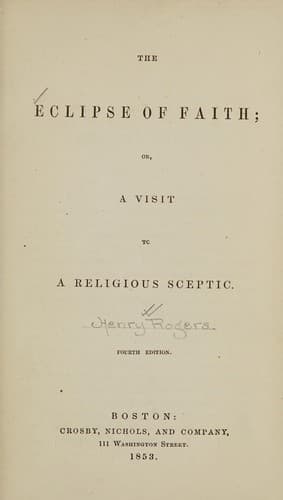
The Eclipse of Faith; Or, A Visit to a Religious ScepticRogers, Henry
Religion
The Eclipse of Faith; Or, A Visit to a Religious Sceptic
Rogers, Henry
Skepticism -- Controversial literature
"Do you not? and yet I think it is a perfectly legitimate inference.
Does not Strauss argue that certain discrepancies are to be observed,
certain apparent contradictions and inconsistencies detected, in the
New Testament narratives; and that therefore we are to reckon, if not
the whole, yet by far the larger part, as utterly fabulous or doubtful,
mythic or legendary? Now, I cannot but feel, on the other hand, that
these narratives are as strikingly marked by all the usual indications
of historic truthfulness as any historic writings in the world. The
artlessness, simplicity, and speciality of the narrative,--a certain
inimitable tone and air of reality, earnestness, and candor,--the
general harmony of these so-called sacred writers with themselves and
with profane authors (quite as general, to say the least, as usually
distinguishes other narratives by different hands),--above all, the
long-concealed, and yet most numerous 'coincidences' which lie deep
beneath the surface and which only a very industrious mind brings to
light; coincidences which, if ingenuity had been subtle enough to
fabricate, that same ingenuity would have been too sagacious to conceal
so deep, and which are too numerous and striking (one would imagine)
to be the effect of accident;--all these things, I say, would seem
to argue (if any thing can) the integrity of the narrative. Yet all
these things must necessarily, of course, go for nothing, on Strauss's
hypothesis. There are, you say, certain discrepancies, and from them
you proceed to conclude that the narrative is uncertain, and unworthy
of credit; that, if there be a residuum of truth at all, no man can
know with any certainty what or how much it is. We must there-fore
leave the whole problematical. Now the question comes, whether we must
not in consistency apply the same principle further; and, if so, whether
we can find in any history whatever stronger marks of credibility;
whether any was ever submitted to an examination more severe, or so
severe; whether any can boast of a larger number of minds, of the
first order, giving their assent to it."
"Let me stop you there," said the other; "you must consider that
those minds were prejudiced in favor of the conclusion. They were
inclined to believe the supernatural wonders which these pretended
historians retail."
Public-domain text, read in full here on John Shaqi.
Reviews
Reviews
No reviews yet
Be the first to share your thoughts on this work.
Elsewhere in the archive
Join the Discussion
Join the discussion
Sign in to leave a comment or review.
Sign InorCreate an account