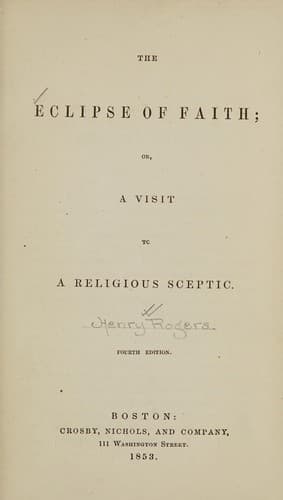
The Eclipse of Faith; Or, A Visit to a Religious ScepticRogers, Henry
Religion
The Eclipse of Faith; Or, A Visit to a Religious Sceptic
Rogers, Henry
Skepticism -- Controversial literature
"I believe that it is simply our proximity to the events which
renders it difficult to entertain them. If the injuries of time and
the caprice of fortune should in the remote future leave as large gaps
in the evidence, and as large scope for ingenious plausibilities, as
in relation to the remote past, I believe multitudes would find no
difficulty in entertaining those 'doubts.' They seem to me perfectly
well argued, and absolutely conclusive on the historic canons on
which Strauss's work is constructed,--namely, that if you find what
seem discrepancies and improbabilities in a reputed history, the mass
of that historic texture in which they are found may be regarded as
mythical or fabulous, doubtful or false. If you say the principles of
Strauss are false, that is another matter. I shall not think it worth
while to contest their truth or their falsehood with you. But if you
adhere to them, I will take the liberty of showing you that you do not
hold them consistently, if you think any remote history is to be
regarded as absolutely placed beyond doubt."
"Well, if you will be grave," said Robinson, "though, upon my word.
I thought you in jest,--is it possible that you do not see that there
is a vast difference between rejecting, on the same ground of
discrepancies, the credibility of the narratives of the Gospel, and
that of any common history?"
"I must honestly confess, then, that I do not, if the discrepancies,
as Strauss alleges, and not something else, is to be assigned as the
cause of their rejection. If indeed, like some criminals under despotic
governments, they are apprehended and convicted on a certain charge,
but really hanged for an entirely different reason, I can understand
that there may be policy in the proceeding; but I do not comprehend
its argumentative honesty. Be pleased, therefore, (that I may form
some conclusion,) to tell me what are those circumstances which so
wonderfully discriminate the discrepancies in the New Testament
histories from those in other histories, as that the inevitable
consequence of finding a certain amount of discrepancies in the former
leads to the rejection of the entire, or nearly entire, documents
in which they are found, while their presence in other histories even
to a far greater extent shall not authorize their rejection at all,
or the rejection only of the parts in which the discrepancies are found.
And yet I think I can guess."
"Well, what do you guess?"
"That you think that the miraculous nature of the events which form
a portion of the New Testament history makes a great difference in
the case."
"And do not you?"
Public-domain text, read in full here on John Shaqi.
Reviews
Reviews
No reviews yet
Be the first to share your thoughts on this work.
Elsewhere in the archive
Join the Discussion
Join the discussion
Sign in to leave a comment or review.
Sign InorCreate an account