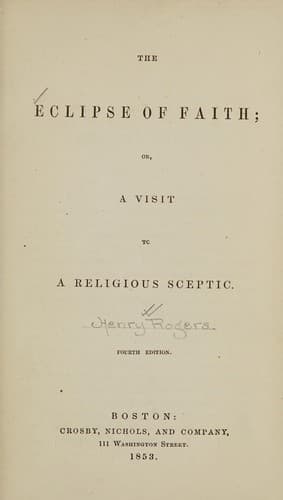
The Eclipse of Faith; Or, A Visit to a Religious ScepticRogers, Henry
Religion
The Eclipse of Faith; Or, A Visit to a Religious Sceptic
Rogers, Henry
Skepticism -- Controversial literature
"You have omitted," said I, "one character,--that of the sceptic, who
believes in no medicine at all; who sturdily dies with his doubts
unresolved, and unattended by any physician. But it must be confessed
that he is a still rarer character than the sceptic in religion. Nature,
my dear Harrington, everywhere decides against you."
"I acknowledge," he said, "that we are but a scanty flock in any
department of life; but, upon my word, the parallel you have suggested
is so striking, that I think I must in consistency, extend my scepticism
to physic at least, and, if I am ill, refrain from availing myself of
so uncertain an art, practised by such uncertain hands and which are
to be selected by one who cannot even guess whether they are ignorant
or skilful;--doctors, who may perhaps, as Voltaire said, put drugs of
which they know nothing into bodies of which they know still less."
"Act upon that resolution, Harrington," said I, "and you will at
least be consistent: but, depend upon it, nature will confute you."
"Why," said he, jestingly, "perhaps in the case of medicine, at all
events, I might face the consequences of scepticism'. I remember
reading, in some account of Madagascar, that the natives are absolutely
without the healing art; 'and yet,' says the author, with grave
surprise, 'it is not observed that the number of deaths is increased.'
Perhaps, thought I, that is the cause of it."
"The statistics," I replied, "of more civilized countries amply refute
you, and show you that, uncertain as is the evidence on which God
has destined and compelled men to act in this, the most important
affair of the present life, and absolute as is the faith they are
summoned to exercise, neither is the study of the art (uncertain as
it is in itself), nor the dependence of patients upon it (still more
precarious as that is), unjustified on the whole by the result; and
as to the abuses of downright quackery, a little prudence and common
sense are required, and are sufficient to preserve men from them."
He mused, and, I thought, seemed struck by this analogy between man's
temporal and spiritual condition I said no more, hoping that he
would ponder it.
____
July 25. I had been so much interested in the discussion between
Harrington and young Robinson on the fair application of the principle
of Strauss to history in general, that I could not resist the
temptation to tell the youth, in secret, that I thought the matter
would admit of further discussion, and that he would do well to
challenge Harrington plausibly to show that some undoubted modern
event might, when it became remote history, be rendered dubious to
posterity. He willingly acted on the hint the next morning. To some
remark of his, Harrington replied thus:--
Public-domain text, read in full here on John Shaqi.
Reviews
Reviews
No reviews yet
Be the first to share your thoughts on this work.
Elsewhere in the archive
Join the Discussion
Join the discussion
Sign in to leave a comment or review.
Sign InorCreate an account