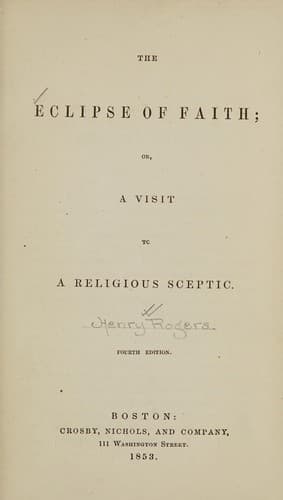
The Eclipse of Faith; Or, A Visit to a Religious ScepticRogers, Henry
Religion
The Eclipse of Faith; Or, A Visit to a Religious Sceptic
Rogers, Henry
Skepticism -- Controversial literature
and left to the mercy of the great destroyer. But the very existence of
any such repository is itself a very doubtful supposition. Comprehensive,
indeed, may be the destruction of many large portions of our archives,
essentially necessary to minute accuracy at so distant a date; nay,
England herself may have ceased to exist. If her subterranean fuel be
not exhausted, a cheaper and equally abundant supply of it may have
been found elsewhere, and transfer for ever the chief elements of her
manufacturing or commercial prosperity; or entirely new and more
transcendent sources of science may have done the same thing, and our
country may be left, like a stranded vessel, to rot upon the beach!
Her furnaces extinguished, her manufactories deserted, her cities decayed,
the hum of her busy population silenced, she may present a spectacle of
desolation like that of so many other famous nations which have risen,
culminated, and set for ever."
"Or," interrupted I, "(and may God avert the omen!) the same ruin may
be accomplished still earlier, and by more potent causes. Her nobles
enervated by luxury, her lower classes sunk in vice and ignorance,
and both the one and the other decaying in piety and religion (a sure
result of neglecting that Bible which has directly and indirectly formed
her strength), she may have fallen a victim to the consequences of her
own degeneracy, or to an irresistible combination of the enemies who
envy and hate her. That picture of the splendid imagination of the great
historian of our day may be realized, 'when some traveller from New
Zealand shall, in the midst of a vast solitude, take his stand on a
broken arch of London Bridge to sketch the ruins of St. Paul's.'"
"In short," resumed Harrington, "in several ways that appalling
catastrophe may have taken place; and, should this be the case, how
many questions will be asked of history, but asked in vain! As for
Rome,--what other great name in the present strife pitted against
England,--for aught we can tell, she may by that time be in desolation
far more remediless than when the grim Attilas and Alarics stormed her
walls. For aught we know, the agency of those terrible elements which
more or less mine the soil of Italy may have made her 'like unto'
Herculaneum or Pompeii; or that silent desolater, the malaria, which
Dr. Arnold thinks will be perpetual and will increase, may long before
that period have reduced, not only the Campagna of Rome, but the whole
region of the 'seven hills,' to a pestilential solitude."
"But all this is mere vision?" said Robinson.
Public-domain text, read in full here on John Shaqi.
Reviews
Reviews
No reviews yet
Be the first to share your thoughts on this work.
Elsewhere in the archive
Join the Discussion
Join the discussion
Sign in to leave a comment or review.
Sign InorCreate an account