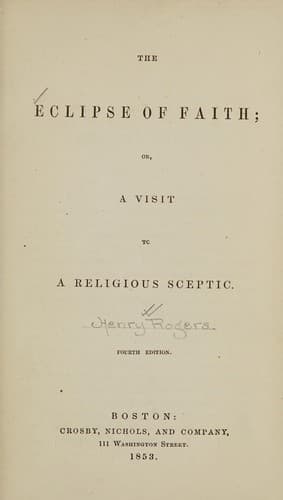
The Eclipse of Faith; Or, A Visit to a Religious ScepticRogers, Henry
Religion
The Eclipse of Faith; Or, A Visit to a Religious Sceptic
Rogers, Henry
Skepticism -- Controversial literature
"It is hardly worth while to contend about the difference," he
replied, with a sarcastic expression which I did not much like.
"It is sufficient to say, however, that these projectors have no
reason to complain; for with whatever show of reason men think or
act here, so under exactly the same laws of thought and emotion do
those shadows act there."
"But I, who am now awake and perfectly sensible--"
He laughed outright. "Are you so sure," said he, "that you are awake.
How do you know it?"
"Because I am conscious of it," said I.
"And this too, I suppose, is a philosopher," he muttered to himself.
"Well," he continued aloud, "we must not discuss these matters just now;
you must believe me when I say that the communities to which our
experimenters go to work, on their own hypotheses, are just as capable
of ingenious reasoning and impartial and candid deliberation, as you are
now in your present waking moments. You wish to hear a few of these
experiments?"
I nodded.
"Well, then, first, there was one worthy philosopher, who, having seen
the advantages which infidelity has gained from the discrepancies and
other difficulties occasioned by the varied testimonies which the
evangelical historians have left behind them, resolved, after having
wrought a number of splendid miracles (uniformly affirmed and never
denied by the parties in whose presence they were performed), that
they should all be consigned to one single history., so admirably
constructed that there was not a single discrepancy from beginning
to end."
"And what was the effect?"
"Why, in the first place, you must recollect that, according to that
or any other mode of authenticating a divine communication by miracles,
there were a great many more of those who never saw the miracles than
of those who did; for if miracles had been common, they would have
ceased to be miracles. There were vast numbers, therefore, who, even
in the age in which they were performed, never believed them; but,
what is more, in four generations there was not a soul that did
not treat them as old wives' fables."
"Surely they were very unreasonable," I said.
"Not at all; it was inevitable; for it was asked (and every one assented
to it), whether it was reasonable that a story so marvellous, and so
contrary to experience, should be believed on any single testimony,
however unexceptionable? There were also keen critics who said, that,
as there was proof that in the very age in which the miracles were
wrought there were many who did not believe the message which they
professedly confirmed, it was a strong indication that the whole was a
fiction; while some others of still greater acumen discovered that the
very freedom from all discrepancies and contradictions in the account
itself smelt very strongly of art and design; that this perfection of
consistency was not the characteristic of any history ever written by
an honest man, and that no doubt it had been elaborately contrived by
a single highly inventive mind."
Public-domain text, read in full here on John Shaqi.
Reviews
Reviews
No reviews yet
Be the first to share your thoughts on this work.
Elsewhere in the archive
Join the Discussion
Join the discussion
Sign in to leave a comment or review.
Sign InorCreate an account