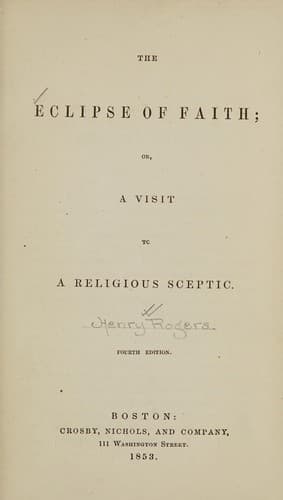
The Eclipse of Faith; Or, A Visit to a Religious ScepticRogers, Henry
Religion
The Eclipse of Faith; Or, A Visit to a Religious Sceptic
Rogers, Henry
Skepticism -- Controversial literature
"Why," said the youth, with a little flippancy, but with a good-humored
laugh too, "the proverb says 'Even a fool may ask questions which a
wise man cannot answer.'"
"I acknowledge myself to be a fool" said Harrington, with a half
serious, half comic air; "and you shall be the wise man who does not
--for I will not say cannot--answer the fool's question."
"I beg your pardon," said the other. "I acknowledge that it was an
uncourteous expression."
"Enough said," replied Harrington; "and now, since you are not pleased
to answer my question, I will answer it myself; and I say, it is plain
that the evidence to which you refer does affirm equally the truths
you declare thus revealed to you, and the errors you declare you must
reject. Now either the evidence is not sufficient to prove the one, or
it is sufficient to prove both. So far, then, I think we may say, and
say justly, that the supposed revelation is so constructed that you
cannot accept a part and reject a part, on such a theory. But to make
the case a little plainer still, if possible. There have been men, you
know, who have taken precisely opposite views of the two doctrines you
have mentioned; who have declared that the doctrine, not of man's
immortality, but of the resurrection, so far from being conceivable,
is, in their judgment, a physical contradiction; but who have also
declared that the doctrine of atonement, in some shape, is instinctively
taught by human nature, and has consequently formed a part of almost
every religion; that it is in analogy with many singular facts of this
world's constitution, and is not absolutely contradicted by any principle
of our nature, intellectual or moral. Such a man, therefore, might take
the very opposite of the course you have taken. He would proceed upon
your common basis of a miraculously confirmed revelation, grossly infested
with errors and falsehoods; he might say that he believed the
authentication of the doctrine of 'atonement' in virtue of the evidence,
because, though transcendental to his reason, it was not repugnant to
it; but that he rejected the doctrine of the 'resurrection,' though
equally established by the evidence, because contrary to the plainest
conclusions of his reason."
"I cannot in candor deny," said the other, "the possibility of such a
case."
"And in such a case, we might say, he does the very opposite of what
you do."
"Neither can I help admitting that."
Public-domain text, read in full here on John Shaqi.
Reviews
Reviews
No reviews yet
Be the first to share your thoughts on this work.
Elsewhere in the archive
Join the Discussion
Join the discussion
Sign in to leave a comment or review.
Sign InorCreate an account