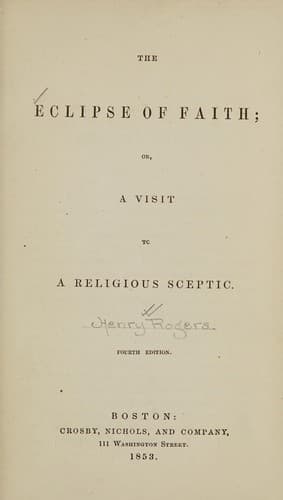
The Eclipse of Faith; Or, A Visit to a Religious ScepticRogers, Henry
Religion
The Eclipse of Faith; Or, A Visit to a Religious Sceptic
Rogers, Henry
Skepticism -- Controversial literature
"Fair and candid once more; but then, I suppose you will admit that
the divine truths which he was, nevertheless, commissioned to teach
mankind, will, like any other truths, be much affected by the mode
in which they are represented to the imagination; will become brighter
or more obscure, more animated or more feeble, and even more just or
distorted, as this task is wisely and judiciously, or preposterously
performed?"
"No doubt."
"Then it appears, I think, that, if there were nothing to control the
Apostle Paul's manner of exhibiting divine verities, even in relation
only to the imagination, there might be all the difference between
sober truth and fanatical perversions of it. I might, in the same manner,
proceed to show that the feelings, uncontrolled by a superior influence,
would be also likely to give distortion or exaggeration to the doctrines.
But it is enough. It appears very plain, that, according to your
hypothesis, even though the Apostles were commissioned to teach by
supernatural illumination certain truths, yet that, being liable to be
infected with all the faults of false history, bad logic, vicious
rhetoric, fanatical feeling, these divine truths might, possibly, be
most falsely presented to us. We have, really, no guaranty but your
gratuitous 'supposition' that they have been taught at all. We have no
criterion for separating what is thus divine from what is merely human.
I fear, therefore, your distinction will not hold. The stream, whatever
the crystal purity of its fountain, could not fail to be horribly impure
by the time it had flowed through such foul conduits."
"In short," continued Harrington, with a bitter smile at the same time,
"there are but three consistent characters in the world; the Bible
Christian, and the genuine Atheist,--or the absolute Sceptic."
"No,--no,--no," exclaimed the whole trio at once; "and you yourself
must be true to your principles, and therefore sceptical as to this."
"It is" he replied, "one of the very few things which I am not sceptical
about. At all events, right or wrong, I am, as usual, willing to give
you my reasons for my belief."
"Rather say your doubts," said Fellowes.
"Well, for my doubts, then. You see, my friends, the matter is as
follows. The Christian speaks on this wise:--
Public-domain text, read in full here on John Shaqi.
Reviews
Reviews
No reviews yet
Be the first to share your thoughts on this work.
Elsewhere in the archive
Join the Discussion
Join the discussion
Sign in to leave a comment or review.
Sign InorCreate an account