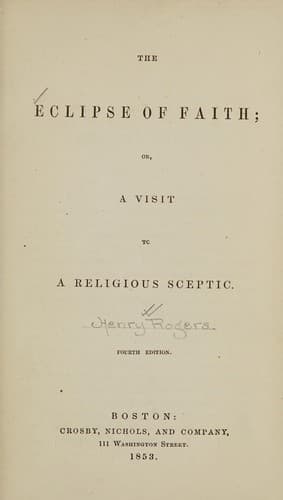
The Eclipse of Faith; Or, A Visit to a Religious ScepticRogers, Henry
Religion
The Eclipse of Faith; Or, A Visit to a Religious Sceptic
Rogers, Henry
Skepticism -- Controversial literature
Admitting, for the sake of argument, that the whole of Christianity
is a delusion; that Christ never lived, and therefore never died; that
he is a more palpable myth than even Dr. Strauss contends for; still
it is impossible not to see that the writers of the New Testament
represent his love for man as the ideal of pure, disinterested,
self-sacrificing affection; this appears whether we listen to the
words which the Evangelists have put into his mouth, or those in
which they have spoken of him. "Greater love hath non man than this
that a man lay down his life for his friends." Now, let there be as
much or as little historic truth in such statements, in the doings
and sufferings of Christ on behalf of humanity, as you will, the
conclusion is irresistible that his conduct (real or imaginary) is
set forth as the exhibition of unequalled patience, gentleness,
meekness, and forbearance; of a love anxious to purchase, at the
dearest cost, the purest and highest happiness of its objects. Now
such is the pattern of affection which the Apostles commend to the
imitation of "husbands and wives" in their conduct towards one
another. Such is to be the lofty standard which their love is to
emulate. Is it possible to go further? Does not the fantastical
observance, or rather the absolute idolatry of women cherished
by chivalry,--itself, however, rooted in the influences of a corrupt
Christianity,--look like a caricature beside the picture? And who
are the "poets of Germanic culture" who have risen to an equal ideal
of the reciprocal duties and sentiments of wedded life? I must contend
that so beautiful a picture of a real equality between man and
woman,--founded on the love of the common Lord of both,--such a picture
of woman's true elevation, was never realized in the ancient world,
nor would have been to this day had not Christianity been
promulgated; nor is now, except where Christianity is known, though,
alas! not always where it is. But if you think otherwise, beg
Mr. Newman to give you a catena of passages from the "poets of Germanic
culture" (he has not adduced a syllable in proof); and recollect it
ought to be from Germanic poets who lived before the Germans were
Christians! Or perhaps you would wish to seek the Germanic "sentiment"
towards woman pure in its source, as given in the certainly not
unfavorable estimate of Tacitus. In their respect for woman and the
stress they laid on chastity, the ancient Germans transcended without
doubt many savages. Still, few readers will suppose there was much
reason to boast of the elevation of women, or the presence of much
refined "sentiment" between the sexes! As long as women do all the
drudgery of house and field work, while their lazy husbands drink and
gamble; as long as they are liable (and their children too) to be sold
or put on the hazard of a cast of the dice; as long as they are
themselves ferocious enough to go out to battle with their husbands;
Public-domain text, read in full here on John Shaqi.
Reviews
Reviews
No reviews yet
Be the first to share your thoughts on this work.
Elsewhere in the archive
Join the Discussion
Join the discussion
Sign in to leave a comment or review.
Sign InorCreate an account