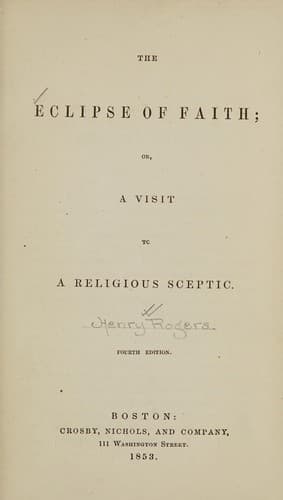
The Eclipse of Faith; Or, A Visit to a Religious ScepticRogers, Henry
Religion
The Eclipse of Faith; Or, A Visit to a Religious Sceptic
Rogers, Henry
Skepticism -- Controversial literature
I found it very difficult to attack him in the intrenchments he had
thrown up. I thought I would just try for a moment to act on the
Spiritualist's advice, and, throwing aside all "intellectual and
logical processes," all appeals to the "critical faculties," advance
"lightly equipped as Priestley himself," making my appeal to the
"spiritual faculty." I cannot say that the result was at all what
"spiritualism" promises. On the contrary, Harrington parried all such
appeals in a twinkling. He said he did not admit that he had any
"spiritual faculty" which acted in isolation from the intellect;
that religious faith must be founded on religious truth, and even
quasi-religious faith on quasi-religious truth. That the intellect
and the moral and spiritual faculties (if he had any) acted together,
since he felt that he was indivisible, and that the former man
be satisfied as well as the latter; that it was so with all
his faculties, none of which acted in isolation; that however
hunger might prompt to food, he never took what his senses of sight
and touch told him was sand or gravel; that if he indulged love, or
pity, or anger, it was only as the senses and the imagination and
the understanding were busied with objects adequate to elicit them;
that if beautiful poetry excited emotion, it was only as he understood
the meaning and connection of the words. "And what else are you doing
now, while urging me to realize by direct 'insight,' by 'gazing' on
'spiritual truth,' and so forth, the things you wish me to realize,
--I say what are you doing but appealing to me, through these same
media of the senses and the imagination, by rhetoric and logic? How
else can you gain any access to my supposed 'spiritual faculties'?"
I replied, that even the spiritualist did that,--he endeavored to
convince men, I supposed. "Yes," he replied, laughing, "because he
is privileged doubly to abuse logic at one and the same time; to
abuse it in one sense as a fallacious instrument of religious conviction
in the hands of others, and to abuse it in another sense, as an
instrument of fallacious conviction in his own. But you are not so
privileged."
Harrington insisted on the fact, that the whole thing was a delusion;
I might appeal, he said, if I thought proper, to any faculties, or
rudiments of faculties, he possessed, spiritual or otherwise; but he
really could not pretend even to comprehend one syllable I said, if
I denied him the use of his understanding. I might as well, and for
the same reasons, appeal to him without the intervention of his senses,
--for his "soul" could not be more different from his "intellect" than
from them. "Besides," he continued, "I know you do not imagine that any
spiritual faculty acts thus independently of the intellect; and
therefore you are only mocking me."
I thought it best to cut my cable and leave this unsafe anchorage.
Public-domain text, read in full here on John Shaqi.
Reviews
Reviews
No reviews yet
Be the first to share your thoughts on this work.
Elsewhere in the archive
Join the Discussion
Join the discussion
Sign in to leave a comment or review.
Sign InorCreate an account