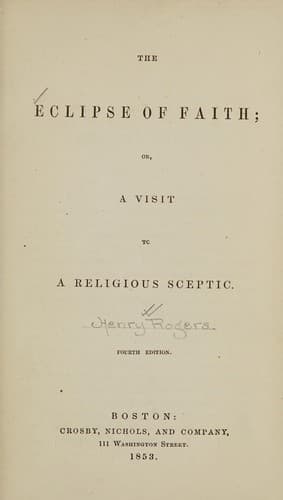
The Eclipse of Faith; Or, A Visit to a Religious ScepticRogers, Henry
Religion
The Eclipse of Faith; Or, A Visit to a Religious Sceptic
Rogers, Henry
Skepticism -- Controversial literature
We had been talking on till long past midnight; and the lamp suddenly
warned us that its light was just expiring. Harrington took off the
shade, and was about to light a candle by the dying flame, when it
went out. "It matters not," he said, "I have the means of kindling a
light close at hand." "Let it alone," said I, rising, and gently laying
my hand on his arm, and speaking in a low voice, but with much
earnestness; "this darkness is an emblem of our present life. You
cannot see me, but you hear my voice and feel the touch of my hand. For
any thing you know, I may be seized with a sudden fit of insanity. I may
be about to stab you in this darkness; such things have been. You have
lost, with the light, more than half the indications of affection which
that would disclose. But you trust to the probable; your pulse does not
beat any the quicker, nor do your nerves tremble. You may have similar,
nay, how much stronger proofs (if you will) of the confidence with which
you may trust God, and Him, the compassionate One, "whom he hath sent,"
in spite of all the gloom in which this life is involved. That certainty
for which you have just now asked will only be granted when the darkness
is passed away; and then you will 'rejoice in the light of his
countenance.' And, further," I continued, "there is yet one thing which
I wish to say to you; and I feel as if I could say it better in this
darkness; for I will not venture to say that I should not manifest more
feeling than is consistent in a hard-hearted metaphysician. Yes! it
is on the side of feeling that I would also address you. You will say,
feeling is not argument? No; but is man all reason? I firmly believe,
indeed, that man is not called upon to do any thing for which his
reason does not tell him that he has sufficient evidence; but a part
of that very evidence is often the dictate of feeling; and genuine
reason will listen to the heart, as not always, nor perhaps more
frequently than otherwise, a suspicious pleader. If, as Pascal says
so truly, it sometimes has its reasons which the reason cannot
comprehend, it has also its reasons which the reason thoroughly
understands.
Public-domain text, read in full here on John Shaqi.
Reviews
Reviews
No reviews yet
Be the first to share your thoughts on this work.
Elsewhere in the archive
Join the Discussion
Join the discussion
Sign in to leave a comment or review.
Sign InorCreate an account