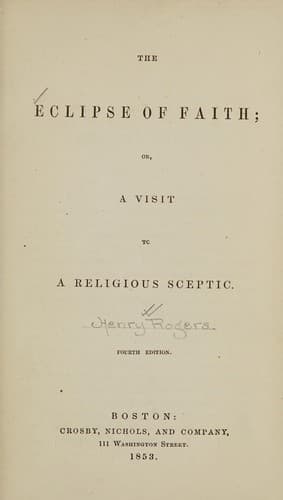
The Eclipse of Faith; Or, A Visit to a Religious ScepticRogers, Henry
Religion
The Eclipse of Faith; Or, A Visit to a Religious Sceptic
Rogers, Henry
Skepticism -- Controversial literature
"How different," said Harrington, "are the experiences of mankind!
You well described those internal oracles, if there are indeed such,
as whispering their responses; if they utter them at all, it is to
me in a whisper so low that I cannot distinctly catch them. Strange
paradoxes! the soul speaks, and the soul listens, and the soul cannot
tell what the soul says. That is, the soul speaks to itself, and says,
'What have I said?' I assure you that the ear of my soul (if I may so
speak) has often ached with intense effort to listen to what the tongue
of the soul mutters, and yet I cannot catch it. You tell me I have
only to look down into the depths within. Well, I have. I assure you
that I have endeavoured to do so, as far as I know, honestly; and,
so far from seeing clear and bright those splendors which you speak
of, I can only see as in the depths of a cavern occasional gleams of
a tremulous flickering light, which distinctly shows me nothing, and
which, I half suspect, comes from without into these recesses: or I
feel as if gazing down an abyss, the bottom of which is filled with
water; the light--and that, too, for aught I know, reflected from
without--only throws a transient glimpse of my own image on the
surface of the dark water; that image itself broken and renewed as
the water boils up from its hidden fountain. Or, if I may recur to
your own metaphor, instead of hearing in those deep caverns the
clear oracles of which you boast, I can distinguish nothing but
a scarcely audible murmur; I know not whether it be any thing more
than the lingering echoes of what I heard in my childhood: or,
rather, my soul speaks to me on all these momentous subjects much
as one in sleep often does; the lips move, but no sound issues
from them. I retire from these attempts, as those of old from the
cave of Trophonius, pale, terrified, and dejected. In short," he
continued, "I feel much as Descartes says he did when he had denuded
himself of all his traditional opinions,--a condition so graphically
described in the beginning of the second of his Meditations. There is
this difference, however, and in his favor: that he imposed upon
himself only a self-inflicted doubt, which he could terminate at any
time. His opinions had been but temporarily laid aside. They were on
the shelf, close at hand, ready to be taken down again when wanted. But
enough of this. You will, I know, aid me, if you can. And, now I think
of it, do so on one point, by justifying your assertion, made the
other evening, as to Mr. Newman's dilemma of the 'impossibility of
a book-revelation.'"
"I said, I think, that Mr. Newman has satisfactorily proved to me
that a book-revelation of moral and spiritual truth is impossible;
that God reveals himself to us within, and not from without."
Public-domain text, read in full here on John Shaqi.
Reviews
Reviews
No reviews yet
Be the first to share your thoughts on this work.
Join the Discussion
Join the discussion
Sign in to leave a comment or review.
Sign InorCreate an account