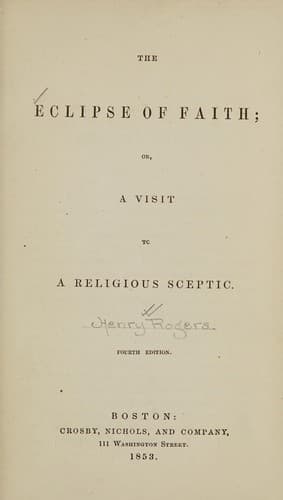
The Eclipse of Faith; Or, A Visit to a Religious ScepticRogers, Henry
Religion
The Eclipse of Faith; Or, A Visit to a Religious Sceptic
Rogers, Henry
Skepticism -- Controversial literature
"As to what is impossible," said the other, "I fancy it would be
difficult to get one thoroughly convinced of his ignorance and
feebleness to be other than very cautious how he used the word.
Perhaps, however, Mr. Newman may be more readily excused than most
men for the strength with which he pronounces his opinions; for,
as he has passed through an infinity of experiences, it may have
given him 'insight' into many absurdities which, to the generality
of mankind, do not appear such. I think if I had believed half so
many things, I should have lost all confidence in myself. What a
strong mind, or what buoyant faith, he must have!"
"Both,--both," said Fellowes.
"Well, be it so. But let us, as you promised yesterday, examine this
very point." This led on to a dialogue in which it was distinctly
proved that
THAT MAY BE POSSIBLE WITH MAN, WHICH IS
IMPOSSIBLE WITH GOD.
"Mr. Newman affirms, you say," said Harrington, "that in his judgment
every book-'revelation' is an absurdity and a contradiction; or, in
the words quoted by you, 'impossible.'"
"Yes,--of 'moral and spiritual truth.'"
"And of any other truth--as of historical truth--you say such
revelation is unnecessary?"
"Yes."
"Moreover, as you and Mr. Newman affirm, the bulk of mankind are
not competent to investigate the claims of such an historic
revelation?"
"Certainly."
"And, therefore, it is impossible in fact, if not per se, unless
God is to be supposed doing something both unnecessary and futile."
"I think so, of course," said Fellowes.
"So that all book-revelation is impossible."
"I affirm it."
"Very well,--I do not dispute it. There still remain one or two
difficulties on which I should like to have your judgment towards
forming an opinion: and they are on the very threshold of the subject.
And, first, I suppose you do not mean to restrict your term of a
'book-revelation' to that only which is literally consigned to a
book in our modern sense. You mean an external revelation?"
"Certainly."
"If, for example, you could recover a genuine manuscript of Isaiah
or Paul, you would not think it entitled to any more respect, as
authority, than a modern translation in a printed book,--though it
might be free from some errors?"
"I should not."
"You would not allow that parchment, however ancient, has any
advantage in this respect over paper, however modern?"
"Certainly not."
"Nor Hebrew or Greek over English or German?
"No."
"All such matters are in very deed but 'leather and prunella'?"
"Nothing more."
Public-domain text, read in full here on John Shaqi.
Reviews
Reviews
No reviews yet
Be the first to share your thoughts on this work.
Join the Discussion
Join the discussion
Sign in to leave a comment or review.
Sign InorCreate an account