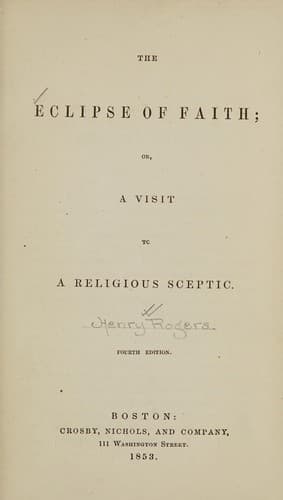
The Eclipse of Faith; Or, A Visit to a Religious ScepticRogers, Henry
Religion
The Eclipse of Faith; Or, A Visit to a Religious Sceptic
Rogers, Henry
Skepticism -- Controversial literature
"Why" said Harrington, laughing, "while you were without the truth,
as you say you were, it was not likely to be authoritative: if,
when you have it, it is recognized as authoritative, which you say
is the case with the truth you have got from Mr. Newman,--if
you acknowledge that it ought to have authority as soon as known,
--that is all (so far as I know) that is contended for in the case
of the Bible. If you mean by 'authoritative' a revelation which not
only ought to be, but which is so, I think mankind make it pretty
plain that neither the 'external' nor the 'internal' revelation is
particularly authoritative. In short," he concluded "I do not see
how we can doubt, on the principles on which Mr. Newman acts and yet
denies, that a book-revelation of moral and spiritual truth is very
possible; and if given, would be signally useful to mankind in general.
If Mr. Newman, as you admit, has written a book which has put you in
possession of moral and spiritual truth, surely it may be modestly
contended that God might dictate a better. Either you were in
possession of the truths in question before he announced them, or you
were not; if not, Mr. Newman is your infinite benefactor, and God may
be at least as great a one; if you were, then Mr. Newman, like Job's
comforters, 'has plentifully declared the thing as it is.' If you say,
that you were in possession of them, but only by implication; that
you did not see them dearly or vividly till they were propounded,
--that is, that you saw them, only practically you were blind, and
knew them, only you were virtually ignorant; still, whatever Mr.
Newman does (and it amounts, in fact, to revelation), that may the
Bible also do. If even that be not possible, and man naturally
possesses these truths explicitly, as well as implicitly, then,
indeed, the Bible is an impertinence,--and so is Mr. Newman."
After a pause, Harrington suddenly asked,--
"Do you not think there is some difference between yourself and
a Hottentot?"
"I should hope so," said Fellowes, with a laugh.
"But still the Hottentot has all the 'spiritual faculties' of which
you speak so much?"
"Certainly."
"What makes this prodigious difference?--for of that, as a fact,
we cannot dispute."
"Different culture and education, I suppose."
"This culture and education is a thing external?"
"It is."
"This culture and education, however, must be of immense importance
indeed, since it makes all the difference between the having or the
not having, practically, any just religious notions, or sentiments,
or practices, (even in your estimation,) whatever our eternal
revelation."
"But still I hold, with Mr. Parker, that the 'absolute religion' is the
same in all men. The difference is in circumstantials only, as
Mr. Parker says."
Public-domain text, read in full here on John Shaqi.
Reviews
Reviews
No reviews yet
Be the first to share your thoughts on this work.
Elsewhere in the archive
Join the Discussion
Join the discussion
Sign in to leave a comment or review.
Sign InorCreate an account