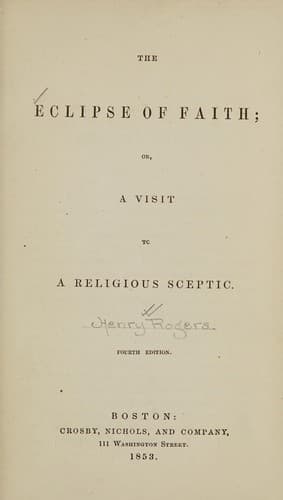
The Eclipse of Faith; Or, A Visit to a Religious ScepticRogers, Henry
Religion
The Eclipse of Faith; Or, A Visit to a Religious Sceptic
Rogers, Henry
Skepticism -- Controversial literature
July 7. Harrington and I spent a portion of this morning alone
(Fellowes was gone out for a day or two), conversing on various
subjects. I hardly know how it was, but I felt a strong reluctance
to enter with formality on that one which yet lay nearest my heart,
--whether from the fear lest I should do more harm than good; lest
controversy should, as so often happens, indurate rather than soften
the heart: or perhaps I had some secret distrust of my own temper or
his. Yet, if I felt any thing of the last, I am sure I did him
injustice; and (I hope) myself. Be it as it may, I thought it better
just to exchange a shot now and then,--sometimes it was a red-hot
shot too on both sides,--as we passed and repassed, in the current
of conversation, than come to a regular set-to, yard-arm to yard-arm.
From whatever cause, he gave me abundant opportunity of recurring to
the subject, for he was perpetually, and I believe unconsciously,
leading the conversation towards it; not, I think, from confidence in
his logical prowess, but from the restlessness in which (he did not
pretend to disguise it) his state of scepticism had plunged him.
It was curious, indeed, to see how every thing, sooner or later,
fell into one channel. For example, I happened to remark, that a
cottage in the valley which we saw from his library window would
make a pretty object in a picture,--it was the only sign of life in
the little valley. "I should like the view itself all the better
without it," said he. I observed that a painter would feel very
differently; and if there were no such object, he would be sure to
put one in. "O, certainly," he replied, "a painter would, and justly;
there is no doubt that the shadow of animated existence is very
admirable; a picture, I admit, is wonderfully more picturesque
with such a picture of life; especially as the painter can and
does remove every thing offensive to his fastidious art. He is
very apt to regard the objects in his landscapes much as a poet
does a cottage, according to Cowper's confession. 'By a cottage,'
says he to Lady Hesketh, 'you must always understand, my dear, that
a poet means a house with six sashes in front, comfortable parlors,
a smart staircase, and three rooms of convenient dimensions.' As I
have looked sometimes down a mountain glen, and seen the most
picturesque huts upon its sides, I have thought how little the
painter could dispense with them. But, then, how easily the
philosopher can: for, alas! I have taken wing from my station, and
looked in through the miserable easement, and seen, not only what
is disgusting to the senses,--which is a small matter,--but ignorance
and disease, and fear, and guilt, and racking pain, and doubt, and
death; and I have not been able to help saying, in pity, 'O for
absolute solitude!--how much nature would be improved if the human
race were annihilated!'"
Public-domain text, read in full here on John Shaqi.
Reviews
Reviews
No reviews yet
Be the first to share your thoughts on this work.
Elsewhere in the archive
Join the Discussion
Join the discussion
Sign in to leave a comment or review.
Sign InorCreate an account