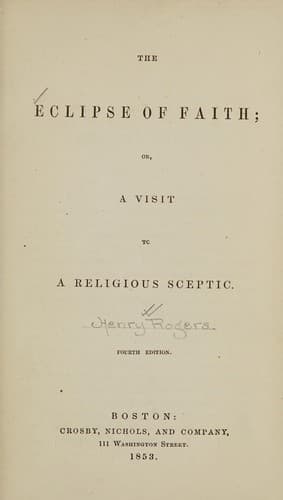
The Eclipse of Faith; Or, A Visit to a Religious ScepticRogers, Henry
Religion
The Eclipse of Faith; Or, A Visit to a Religious Sceptic
Rogers, Henry
Skepticism -- Controversial literature
He gradually resumed conversation; and we discussed the subject of
the "beautiful" for some time. Yet I know not how it was, nor can
I trace the steps by which we deviated,--only that Rousseau's summer
-day dreams on the Lake of Bienne was a link in the chain,--we
somehow soon found ourselves on the brink of the great controversy
respecting the "origin of Evil." "I have read many books on that
subject," said I; "but I intend to read no more; and I should think
you have had enough of them."
"Why, yes," said he, laughing; "whatever philosophers may have thought
of the origin of evil, it is a great aggravation of it to read their
speculations. The best thing I know on the subject--and it exhausts
it--is half a dozen lines in 'Robinson Crusoe.'"
"Robinson Crusoe!" said I.
"Certainly," he replied; "do you not remember that when he caught
his man Friday, the 'intuitional consciousness'--the 'insight'--the
'inward revelation' of that worthy savage not being found quite so
perfect as Mr. Parker would fancy, Robinson proceeds to indoctrinate
him in the mysteries of theology? Friday is much puzzled, as many
more learned savages have been before him, to find that the infinite
power, wisdom, and goodness of God had made every thing good, and
that good it would have continued had not been for the opposition
of the Devil. 'Why God not kill Debbil?' asks poor Friday. On which
says Robinson, 'Though I was a very old man, I found that I was but
a young doctor in divinity.' Ah! if all doctors in divinity had
been equally candid, the treatises on that dread subject would not
have been quite so voluminous; for we close them all alike with the
unavailing question, 'Why God not kill Debbil?'"
Observing this tendency to gravitate towards the abyss, I at last
said to him, 'I think, if I were you, having decided that there is
no religious truth to be found, I should dismiss the subject from
my thoughts altogether. Do as the Indian did, who struggled as
long as he could to right his canoe when he found he was in the
stream of Niagara; but, finding his efforts unavailing, sat himself
down with his arms folded, and went down the falls without stirring
a muscle. Let us talk no more on the subject. Why should you perplex
yourself, as you apparently do, about a thing so hopeless to be
found out as truth? 'What is truth?' said Pilate; and, as Bacon says,
'he would not wait for an answer.' It was a question to which, most
probably, he, like you, thought no answer could be given. If I were
you, I should do the same. Why perplex yourself to no purpose?"
"I should answer," said he, "as Solon did when asked why he grieved
for his son, seeing all grief was unavailing.' It is for that very
reason that I grieve,' was the reply. And in like manner I dwell on
the impossibility of discovering truth because it is impossible."
Public-domain text, read in full here on John Shaqi.
Reviews
Reviews
No reviews yet
Be the first to share your thoughts on this work.
Elsewhere in the archive
Join the Discussion
Join the discussion
Sign in to leave a comment or review.
Sign InorCreate an account