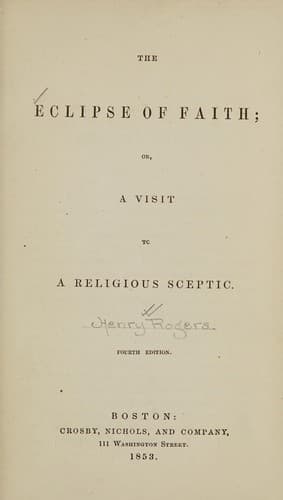
The Eclipse of Faith; Or, A Visit to a Religious ScepticRogers, Henry
Religion
The Eclipse of Faith; Or, A Visit to a Religious Sceptic
Rogers, Henry
Skepticism -- Controversial literature
"Then cease to talk of your 'absolute religion,' as capable in any
way of consecrating the hateful forms of false and cruel superstition for
which you and Mr. Parker condescend to be the apologists. The
fanaticism of such pious and devout beasts as those saint-loving
pirates is not a more flagrant violation of the principle of morality,
than the acts which flow directly as the immediate and natural
expression of the infinitely varied but all-polluting forms of
idolatry with which you are pleased to identify your 'absolute
religion,' and in all of which you suppose an acceptable 'faith' to
be very possible. You see how Mr. Parker extends the apology to
the foulest sets of his Tartar and Calmuck scoundrels; acts
called murders in the codes of Christendom and civilization, but
varnished over by the beautiful 'faith' which somehow still lurks
under the most frightful practices of a simple-minded barbarian. If
this faith will shelter the abominations of a gross idolatry, I see
not what else it may not sanctify.--But, in fact, neither in the
case of idolaters, nor any other religionists, is it true that
'faith' is independent of 'belief'; in the case of your Calmuck, for
example, the 'belief' is vile, and therefore the 'faith' vile too;
faith practical enough, certainly, but one that as certainly does not
'work by love'; and which, I think, would be well exchanged for a
dead orthodoxy, or any thing else."
It is not difficult to see the source of the fallacy into which
Mr. Fellowes had fallen. It lies in the attempt to make a
distinction in fact, as well as in theory, between the
"intellectual" and "emotional" parts of our nature. It is very well
for the spiritual and mental analyst to consider separately the
several principles which constitute humanity, and which act, and
react, and interact, in endless involution. That there may be acts
of belief that terminate chiefly in the intellect, and may be wholly
worthless, who denies? The drunkard, for example, may admit that
sobriety is a duty; but yet, if he gets drunk every night of his
life, we shall, of course, think little of that act of belief,--of
his daily repetition of moral orthodoxy. In the same manner, a man
may admit that it is his duty to exercise implicit love, gratitude,
and obedience towards the great object of worship; but if his
habitual conduct shows that he has no thought of acting in accordance
with this maxim, he must be regarded, in spite of the orthodoxy of
his speculative creed, as no better than a heathen; or worse.
Public-domain text, read in full here on John Shaqi.
Reviews
Reviews
No reviews yet
Be the first to share your thoughts on this work.
Elsewhere in the archive
Join the Discussion
Join the discussion
Sign in to leave a comment or review.
Sign InorCreate an account