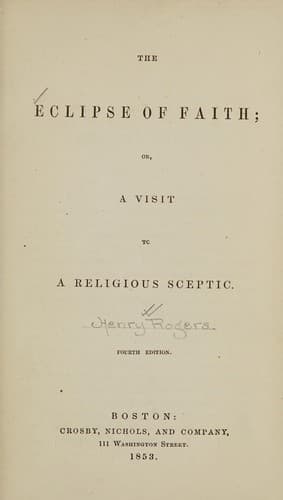
The Eclipse of Faith; Or, A Visit to a Religious ScepticRogers, Henry
Religion
The Eclipse of Faith; Or, A Visit to a Religious Sceptic
Rogers, Henry
Skepticism -- Controversial literature
To affirm that every man has this "Absolute Religion" without
external revelation is much as if a man were to say that we have
an "Absolute Philosophy" on the same terms, in virtue of man's
having faculties which prompt him to philosophize in some way. All
religions contain the Absolute Religion, says Mr. Parker: Just, I
reply, as all philosophies contain the absolute philosophy. The
philosophy of Plato, of Aristotle of Bacon, of Locke, of Leibnitz,
of Reid, are all philosophies, no doubt; but that is all that is
to be said. Even contraries must resemble one another in one point,
or they could not be contrasted. In truth, there is, I think, a
striking analogy between man's spiritual and intellectual condition;
only his intellect is a little less variable than his "spiritual
faculty"; far more so, however, than his senses. His animal nature
is more defined than his intellectual, his intellectual than his
spiritual and moral. All the phenomena point either to an imperfect
organization of his nobler faculties, or to the doctrine of
the "Fall."
But further, surely if this internal oracle exists in man, every
sincere and earnest soul, on interrogating his consciousness, would
hear the indubitable response,--would enjoy the beatific vision of
"spiritual insight." If this be asserted, I for one have to say to
this representation, that, so far as my own consciousness informs
me, I have honestly, sincerely, and with utmost diligence,
interrogated my spirit; and I solemnly protest, that, apart from
those external influences and that external instruction which the
revelation from within is supposed to anticipate and supersede, I am
not conscious that I should have any of the sentiments which either
of these writers make the sum of religion. Even as to that fundamental
position,--the existence of a Being of unlimited power and wisdom, (as
to his unlimited goodness, I believe nothing but an external revelation
can absolutely certify us,) I feel that I am much more indebted to
those influences from design, which these writers made so light of,
than to any clearness in the imperfect intuition: for if I found--and
surely this is the true test--the traces of design less conspicuous
in the external world, confusion there, as in the moral and in both
greater than is now found in either; I extremely doubt whether the
faintest surmise of such a Being would have suggested itself to me.
But be that as it may; as to their other cardinal sentiments,--the
nature of my relations to this Being,--his placability; if offended,
--the terms of forgiveness, if any,--whether, as these gentlemen
affirm, he is accessible to all, without any atonement or
mediator;--as to all this, I solemnly declare, that, apart from
external instruction; I cannot by interrogating my racked spirit,
catch even a murmur. That it must be faint, indeed, in other men,
so faint as to render the pretensions of the certitude of the
internal revelation, and its independence of all external revelation,
Public-domain text, read in full here on John Shaqi.
Reviews
Reviews
No reviews yet
Be the first to share your thoughts on this work.
Elsewhere in the archive
Join the Discussion
Join the discussion
Sign in to leave a comment or review.
Sign InorCreate an account