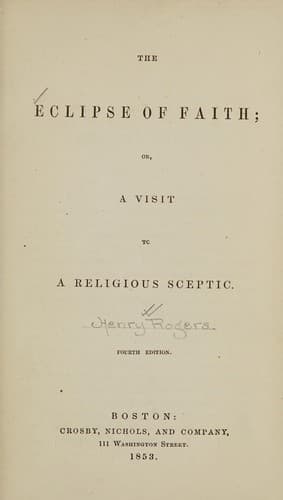
The Eclipse of Faith; Or, A Visit to a Religious ScepticRogers, Henry
Religion
The Eclipse of Faith; Or, A Visit to a Religious Sceptic
Rogers, Henry
Skepticism -- Controversial literature
Reply to it, said he, eagerly; does it require any reply?--However, I
will read what I have written. Is it not plain, that while Mr. Newman
is professedly anatomizing the spiritual nature of man, as man,--the
functions and revelations of that inward oracle which supersedes and
anticipates all external revelations--he is, in fact, anatomizing his
own? What title has he, when avowedly explaining the phenomena of the
religious faculty which he asserts to be inherent in humanity,--though
how they should need explaining, if his theory be true, I know not,--what
title has he, when men deny that they are conscious of the facts he
describes, to raise refuge in his own private revelations, and that of
the few whose privilege it is to be "born again" by a mysterious law
which he says it is impossible for us to investigate? "We cannot
pretend," he says, "to sound the mystery whence comes the new birth,
in certain souls. To reply, 'The Spirit bloweth where He listeth,'
confesses the mystery, and declines to explain it. But it is evident
that individuals in Greece, in the third century before the Christian
era, were already moving towards an intelligent heart-worship or
had even begun to practise it!" (Soul, p.64)
High time, I think, that after some thousands of years some few
individuals should begin to manifest the phenomena of the universal
revelation from within, if such a thing be!
This is not to delineate the religions nature of humanity, but to
reveal--yes, and to reveal externally--the religious nature of the
elect few,--and few they are indeed,--who, by a mysterious infidel
Calvinism, are permitted to attain, by direct intuition, and
independent of all external revelation, the true sentiments and
experiences of "spiritual insight." It this be Mr. Newman's solution
of our difficulties, it is utterly nugatory. It is not to dissect
the soul, "its sorrows and aspirations"; it is merely to give us
the pathology--perhaps the morbid pathology--of Mr. Newman's soul;
its sorrows and its aspirations. If the answer merely respected the
practical value of a theory of spiritual sentiments, which all
acknowledged, then Mr. Newman's answer might have some force; for
certainly, only he who reduced that theory to practice, or attempted
to do so, would have a right to conclude against the experience of
him who did. But it is obvious that the question affects the theory
itself, and especially the consciousness of those terms of possible
communion with God, those relations of the soul to him, on the
reception of which all the said spiritual experience must depend.
Public-domain text, read in full here on John Shaqi.
Reviews
Reviews
No reviews yet
Be the first to share your thoughts on this work.
Elsewhere in the archive
Join the Discussion
Join the discussion
Sign in to leave a comment or review.
Sign InorCreate an account