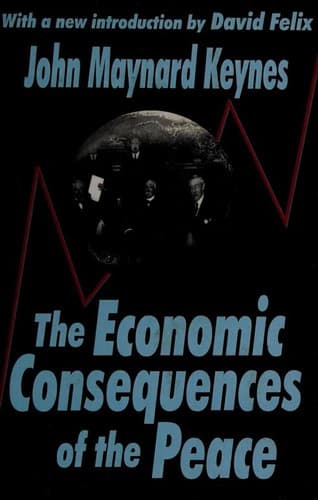
The Economic Consequences of the PeaceKeynes, John Maynard
History
The Economic Consequences of the Peace
Keynes, John Maynard
Economic history -- 1918-1945; Treaty of Versailles (1919 June 28); World War, 1914-1918 -- Economic aspects
Next on the list come cereals, leather goods, sugar, paper, furs,
electrical goods, silk goods, and dyes. Cereals are not a net export and
are far more than balanced by imports of the same commodities. As
regards sugar, nearly 90 per cent of Germany's pre-war exports came to
the United Kingdom.[128] An increase in this trade might be stimulated
by a grant of a preference in this country to German sugar or by an
arrangement by which sugar was taken in part payment for the indemnity
on the same lines as has been proposed for coal, dyes, etc. Paper
exports also might be capable of some increase. Leather goods, furs, and
silks depend upon corresponding imports on the other side of the
account. Silk goods are largely in competition with the trade of France
and Italy. The remaining items are individually very small. I have heard
it suggested that the indemnity might be paid to a great extent in
potash and the like. But potash before the war represented 0.6 per cent
of Germany's export trade, and about $15,000,000 in aggregate value.
Besides, France, having secured a potash field in the territory which
has been restored to her, will not welcome a great stimulation of the
German exports of this material.
An examination of the import list shows that 63.6 per cent are raw
materials and food. The chief items of the former class, namely, cotton,
wool, copper, hides, iron-ore, furs, silk, rubber, and tin, could not be
much reduced without reacting on the export trade, and might have to be
increased if the export trade was to be increased. Imports of food,
namely, wheat, barley, coffee, eggs, rice, maize, and the like, present
a different problem. It is unlikely that, apart from certain comforts,
the consumption of food by the German laboring classes before the war
was in excess of what was required for maximum efficiency; indeed, it
probably fell short of that amount. Any substantial decrease in the
imports of food would therefore react on the efficiency of the
industrial population, and consequently on the volume of surplus exports
which they could be forced to produce. It is hardly possible to insist
on a greatly increased productivity of German industry if the workmen
are to be underfed. But this may not be equally true of barley, coffee,
eggs, and tobacco. If it were possible to enforce a rÈgime in which for
the future no German drank beer or coffee, or smoked any tobacco, a
substantial saving could be effected. Otherwise there seems little room
for any significant reduction.
Public-domain text, read in full here on John Shaqi.
Reviews
Reviews
No reviews yet
Be the first to share your thoughts on this work.
Elsewhere in the archive
Join the Discussion
Join the discussion
Sign in to leave a comment or review.
Sign InorCreate an account