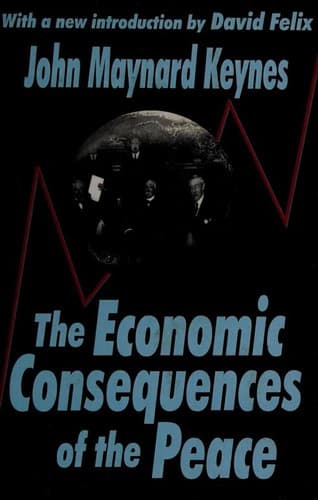
The Economic Consequences of the PeaceKeynes, John Maynard
History
The Economic Consequences of the Peace
Keynes, John Maynard
Economic history -- 1918-1945; Treaty of Versailles (1919 June 28); World War, 1914-1918 -- Economic aspects
A capacity of $40,000,000,000 or even of $25,000,000,000 is, therefore,
not within the limits of reasonable possibility. It is for those who
believe that Germany can make an annual payment amounting to hundreds of
millions sterling to say _in what specific commodities_ they intend this
payment to be made and _in what markets_ the goods are to be sold. Until
they proceed to some degree of detail, and are able to produce some
tangible argument in favor of their conclusions, they do not deserve to
be believed.[131]
I make three provisos only, none of which affect the force of my
argument for immediate practical purposes.
_First_: if the Allies were to "nurse" the trade and industry of Germany
for a period of five or ten years, supplying her with large loans, and
with ample shipping, food, and raw materials during that period,
building up markets for her, and deliberately applying all their
resources and goodwill to making her the greatest industrial nation in
Europe, if not in the world, a substantially larger sum could probably
be extracted thereafter; for Germany is capable of very great
productivity.
_Second_: whilst I estimate in terms of money, I assume that there is no
revolutionary change in the purchasing power of our unit of value. If
the value of gold were to sink to a half or a tenth of its present
value, the real burden of a payment fixed in terms of gold would be
reduced proportionately. If a sovereign comes to be worth what a
shilling is worth now, then, of course, Germany can pay a larger sum
than I have named, measured in gold sovereigns.
_Third_: I assume that there is no revolutionary change in the yield of
Nature and material to man's labor. It is not _impossible_ that the
progress of science should bring within our reach methods and devices by
which the whole standard of life would be raised immeasurably, and a
given volume of products would represent but a portion of the human
effort which it represents now. In this case all standards of "capacity"
would be changed everywhere. But the fact that all things are _possible_
is no excuse for talking foolishly.
It is true that in 1870 no man could have predicted Germany's capacity
in 1910. We cannot expect to legislate for a generation or more. The
secular changes in man's economic condition and the liability of human
forecast to error are as likely to lead to mistake in one direction as
in another. We cannot as reasonable men do better than base our policy
on the evidence we have and adapt it to the five or ten years over which
we may suppose ourselves to have some measure of prevision; and we are
not at fault if we leave on one side the extreme chances of human
existence and of revolutionary changes in the order of Nature or of
man's relations to her. The fact that we have no adequate knowledge of
Germany's capacity to pay over a long period of years is no
justification (as I have heard some people claim that, it is) for the
statement that she can pay $50,000,000,000.
Public-domain text, read in full here on John Shaqi.
Reviews
Reviews
No reviews yet
Be the first to share your thoughts on this work.
Elsewhere in the archive
Join the Discussion
Join the discussion
Sign in to leave a comment or review.
Sign InorCreate an account