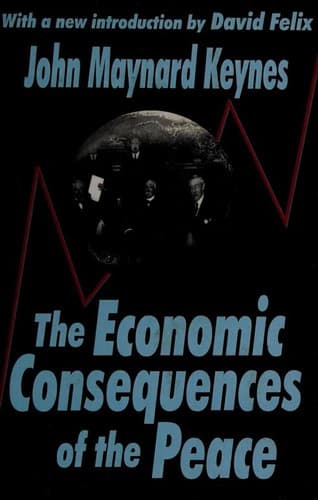
The Economic Consequences of the PeaceKeynes, John Maynard
History
The Economic Consequences of the Peace
Keynes, John Maynard
Economic history -- 1918-1945; Treaty of Versailles (1919 June 28); World War, 1914-1918 -- Economic aspects
13. In general, the Commission, acting through a subordinate body, will
perform the same functions for Austria and Bulgaria as for Germany, and
also, presumably, for Hungary and Turkey.[138]
There are also many other relatively minor duties assigned to the
Commission. The above summary, however, shows sufficiently the scope and
significance of its authority. This authority is rendered of far greater
significance by the fact that the demands of the Treaty generally exceed
Germany's capacity. Consequently the clauses which allow the Commission
to make abatements, if in their judgment the economic conditions of
Germany require it, will render it in many different particulars the
arbiter of Germany's economic life. The Commission is not only to
inquire into Germany's general capacity to pay, and to decide (in the
early years) what import of foodstuffs and raw materials is necessary;
it is authorized to exert pressure on the German system of taxation
(Annex II. para. 12(_b_))[139] and on German internal expenditure, with
a view to insuring that Reparation payments are a first charge on the
country's entire resources; and it is to decide on the effect on German
economic life of demands for machinery, cattle, etc., and of the
scheduled deliveries of coal.
By Article 240 of the Treaty Germany expressly recognizes the Commission
and its powers "as the same may be constituted by the Allied and
Associated Governments," and "agrees irrevocably to the possession and
exercise by such Commission of the power and authority given to it under
the present Treaty." She undertakes to furnish the Commission with all
relevant information. And finally in Article 241, "Germany undertakes to
pass, issue, and maintain in force any legislation, orders, and decrees
that may be necessary to give complete effect to these provisions."
The comments on this of the German Financial Commission at Versailles
were hardly an exaggeration:--"German democracy is thus annihilated at
the very moment when the German people was about to build it up after a
severe struggle--annihilated by the very persons who throughout the war
never tired of maintaining that they sought to bring democracy to us....
Germany is no longer a people and a State, but becomes a mere trade
concern placed by its creditors in the hands of a receiver, without its
being granted so much as the opportunity to prove its willingness to
meet its obligations of its own accord. The Commission, which is to have
its permanent headquarters outside Germany, will possess in Germany
incomparably greater rights than the German Emperor ever possessed, the
German people under its rÈgime would remain for decades to come shorn
of all rights, and deprived, to a far greater extent than any people in
the days of absolutism, of any independence of action, of any individual
aspiration in its economic or even in its ethical progress."
Public-domain text, read in full here on John Shaqi.
Reviews
Reviews
No reviews yet
Be the first to share your thoughts on this work.
Elsewhere in the archive
Join the Discussion
Join the discussion
Sign in to leave a comment or review.
Sign InorCreate an account