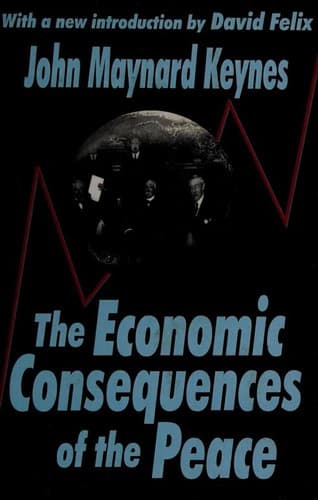
The Economic Consequences of the PeaceKeynes, John Maynard
History
The Economic Consequences of the Peace
Keynes, John Maynard
Economic history -- 1918-1945; Treaty of Versailles (1919 June 28); World War, 1914-1918 -- Economic aspects
The German offer of an alleged sum of $25,000,000,000 amounted to the
following. In the first place it was conditional on concessions in the
Treaty insuring that "Germany shall retain the territorial integrity
corresponding to the Armistice Convention,[140] that she shall keep her
colonial possessions and merchant ships, including those of large
tonnage, that in her own country and in the world at large she shall
enjoy the same freedom of action as all other peoples, that all war
legislation shall be at once annulled, and that all interferences during
the war with her economic rights and with German private property, etc.,
shall be treated in accordance with the principle of reciprocity";--that
is to say, the offer is conditional on the greater part of the rest of
the Treaty being abandoned. In the second place, the claims are not to
exceed a maximum of $25,000,000,000, of which $5,000,000,000 is to be
discharged by May 1, 1926; and no part of this sum is to carry interest
pending the payment of it.[141] In the third place, there are to be
allowed as credit against it (amongst other things): (_a_) the value of
all deliveries under the Armistice, including military material (_e.g._
Germany's navy); (_b_) the value of all railways and State property in
ceded territory; (_c_) the _pro rata_ share of all ceded territory in
the German public debt (including the war debt) and in the Reparation
payments which this territory would have had to bear if it had remained
part of Germany; and (_d_) the value of the cession of Germany's claims
for sums lent by her to her allies in the war.[142]
The credits to be deducted under (_a_), (_b_), (_c_), and (_d_) might be
in excess of those allowed in the actual Treaty, according to a rough
estimate, by a sum of as much as $10,000,000,000, although the sum to be
allowed under (_d_) can hardly be calculated.
If, therefore, we are to estimate the real value of the German offer of
$25,000,000,000 on the basis laid down by the Treaty, we must first of
all deduct $10,000,000,000 claimed for offsets which the Treaty does not
allow, and then halve the remainder in order to obtain the present value
of a deferred payment on which interest is not chargeable. This reduces
the offer to $7,500,000,000, as compared with the $40,000,000,000 which,
according to my rough estimate, the Treaty demands of her.
This in itself was a very substantial offer--indeed it evoked widespread
criticism in Germany--though, in view of the fact that it was
conditional on the abandonment of the greater part of the rest of the
Treaty, it could hardly be regarded as a serious one.[143] But the
German Delegation would have done better if they had stated in less
equivocal language how far they felt able to go.
Public-domain text, read in full here on John Shaqi.
Reviews
Reviews
No reviews yet
Be the first to share your thoughts on this work.
Elsewhere in the archive
Join the Discussion
Join the discussion
Sign in to leave a comment or review.
Sign InorCreate an account