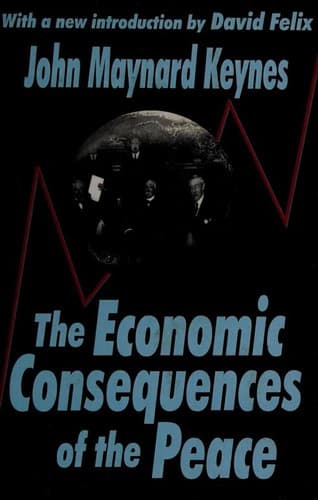
The Economic Consequences of the PeaceKeynes, John Maynard
History
The Economic Consequences of the Peace
Keynes, John Maynard
Economic history -- 1918-1945; Treaty of Versailles (1919 June 28); World War, 1914-1918 -- Economic aspects
I cannot leave this subject as though its just treatment wholly depended
either on our own pledges or on economic facts. The policy of reducing
Germany to servitude for a generation, of degrading the lives of
millions of human beings, and of depriving a whole nation of happiness
should be abhorrent and detestable,--abhorrent and detestable, even if
it were possible, even if it enriched ourselves, even if it did not sow
the decay of the whole civilized life of Europe. Some preach it in the
name of Justice. In the great events of man's history, in the unwinding
of the complex fates of nations Justice is not so simple. And if it
were, nations are not authorized, by religion or by natural morals, to
visit on the children of their enemies the misdoings of parents or of
rulers.
FOOTNOTES:
[76] "With reservation that any future claims and demands of
the Allies and the United States of America remain unaffected, the
following financial conditions are required: Reparation for damage done.
Whilst Armistice lasts, no public securities shall be removed by the
enemy which can serve as a pledge to the Allies for recovery or
reparation of war losses. Immediate restitution of cash deposit in
National Bank of Belgium, and, in general, immediate return of all
documents, of specie, stock, shares, paper money, together with plant
for issue thereof, touching public or private interests in invaded
countries. Restitution of Russian and Roumanian gold yielded to Germany
or taken by that Power. This gold to be delivered in trust to the Allies
until signature of peace."
[77] It is to be noticed, in passing, that they contain nothing
which limits the damage to damage inflicted contrary to the recognized
rules of warfare. That is to say, it is permissible to include claims
arising out of the legitimate capture of a merchantman at sea, as well
as the costs of illegal submarine warfare.
[78] Mark-paper or mark-credits owned in ex-occupied territory
by Allied nationals should be included, if at all, in the settlement of
enemy debts, along with other sums owed to Allied nationals, and not in
connection with reparation.
[79] A special claim on behalf of Belgium was actually included
In the Peace Treaty, and was accepted by the German representatives
without demur.
[80] To the British observer, one scene, however, stood out
distinguished from the rest--the field of Ypres. In that desolate and
ghostly spot, the natural color and humors of the landscape and the
climate seemed designed to express to the traveler the memories of the
ground. A visitor to the salient early in November, 1918, when a few
German bodies still added a touch of realism and human horror, and the
great struggle was not yet certainly ended, could feel there, as nowhere
else, the present outrage of war, and at the same time the tragic and
sentimental purification which to the future will in some degree
transform its harshness.
Public-domain text, read in full here on John Shaqi.
Reviews
Reviews
No reviews yet
Be the first to share your thoughts on this work.
Elsewhere in the archive
Join the Discussion
Join the discussion
Sign in to leave a comment or review.
Sign InorCreate an account